Dense Connective Tissue
Dense Connective Tissue is a specialized type of connective tissue characterized by a high concentration of collagen fibers, providing robust structural support and mechanical strength throughout the body. It plays a crucial role in connecting, supporting, and protecting various organs and tissues.
Key Takeaways
- Dense Connective Tissue is a strong, fibrous tissue rich in collagen, providing tensile strength and resistance to stretching.
- It is primarily composed of fibroblasts and a dense extracellular matrix dominated by collagen fibers.
- This tissue is categorized into two main types: dense regular and dense irregular connective tissue.
- Dense regular connective tissue features parallel collagen bundles, offering strength in one direction, typically found in tendons and ligaments.
- Dense irregular connective tissue has interwoven collagen fibers, providing strength in multiple directions, present in the dermis and organ capsules.
What is Dense Connective Tissue?
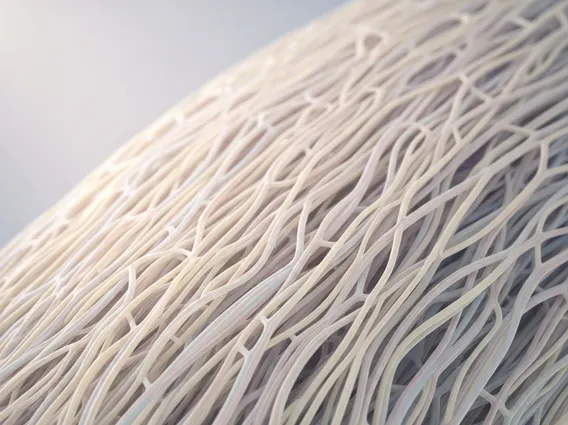
Dense Connective Tissue is a fundamental type of connective tissue distinguished by its abundant and densely packed collagen fibers. These fibers are the primary component of its extracellular matrix, giving the tissue its characteristic strength and resilience. Unlike loose connective tissue, which has more ground substance and fewer fibers, dense connective tissue is built for mechanical stress and structural integrity.
The main cellular component of this tissue is the fibroblast, which synthesizes and secretes the collagen proteins and other matrix components. The high density of collagen fibers, along with a relatively sparse ground substance, allows dense connective tissue to withstand significant tensile forces, making it essential for structures that require strong, durable connections and support within the body.
Dense Regular and Irregular Connective Tissue
The arrangement of collagen fibers dictates the classification of dense connective tissue into two primary types: dense regular and dense irregular. Each type is uniquely adapted to specific mechanical demands within the body, providing strength either in a single direction or across multiple planes.
Dense regular connective tissue is characterized by its collagen fibers being arranged in parallel bundles. This highly organized structure provides immense tensile strength when forces are applied in the direction of the fiber alignment. Conversely, dense irregular connective tissue features collagen fibers interwoven into a haphazard, multidirectional network. This arrangement allows the tissue to resist tension and stretching from various directions, making it suitable for areas subjected to stress from multiple angles.
| Feature | Dense Regular Connective Tissue | Dense Irregular Connective Tissue |
|---|---|---|
| Fiber Alignment | Parallel bundles of collagen fibers | Irregularly interwoven collagen fibers |
| Primary Strength | Unidirectional tensile strength | Multidirectional tensile strength |
| Key Locations | Tendons, Ligaments, Aponeuroses | Dermis, Organ Capsules, Fascia |
Function and Location of Dense Connective Tissue
The primary function of dense connective tissue is to provide strong mechanical support, transmit forces, and resist stretching, thereby protecting and connecting various structures. Its robust nature is crucial for maintaining the structural integrity of the musculoskeletal system and encapsulating organs.
The specific where is dense connective tissue found depends on its type:
- Dense regular connective tissue is predominantly found in structures that require strong, unidirectional resistance to tension. Key locations include:
- Tendons: Connect muscles to bones, transmitting the force generated by muscle contraction to move the skeleton.
- Ligaments: Connect bones to other bones, stabilizing joints and preventing excessive movement.
- Aponeuroses: Flat, sheet-like tendons that attach muscles to other muscles or bones, often found in the abdomen and scalp.
- Dense irregular connective tissue is located in areas where strength and resistance to tearing are needed from multiple directions. Examples include:
- Dermis of the skin: The deep layer of the skin that provides strength and elasticity, resisting forces from various angles.
- Fibrous capsules of organs: Surrounds and protects organs such as the kidneys, spleen, and lymph nodes, as well as joints.
- Periosteum: The dense fibrous membrane covering the surface of bones, providing attachment points for muscles and ligaments.
- Perichondrium: The connective tissue sheath that surrounds most cartilage, providing nutrients and support.
- Fascia: Sheets of connective tissue that enclose and separate muscles, organs, and other structures.
Together, these tissues are indispensable for the body’s structural framework, enabling movement, protection, and the efficient functioning of organ systems.