Myths vs Facts: Skin Cancer on Black Skin

Myths vs Facts: Skin Cancer on Black Skin

Myths vs Facts: Skin Cancer on Black Skin

Dangerous misconceptions about skin cancer and darker skin tones continue to cost lives. Understanding the real risks, warning signs, and prevention strategies is essential for every community, regardless of skin tone or background.

Key Takeaways

  • Black people can and do develop skin cancer, and late diagnosis significantly worsens outcomes.
  • Melanin provides some natural UV protection but does not eliminate the risk of skin cancer.
  • Dermatologists recommend that people of all skin tones use broad-spectrum sunscreen regularly.
  • Skin cancer in people with darker complexions often appears in non-sun-exposed areas, making self-examination critical.
  • Raising skin cancer awareness for African Americans saves lives by encouraging earlier detection and treatment.

Myths vs Facts: Can Black People Get Skin Cancer?

One of the most persistent and dangerous beliefs in public health is that Black people are immune to skin cancer. This myth likely stems from the understanding that melanin — the pigment responsible for darker skin tones — offers some protection against ultraviolet (UV) radiation. While this is partially true, it does not mean Black individuals are protected from developing skin cancer. Skin cancer myths and facts for Black people consistently show that this misconception leads to delayed diagnoses and poorer health outcomes.

According to the Skin Cancer Foundation, while melanoma is less common in people with darker skin, it is far more deadly when it does occur. Studies indicate that the five-year melanoma survival rate for Black Americans has historically been lower than for white Americans — approximately 70% compared to 93% — a gap driven largely by late-stage diagnosis. This disparity is not a reflection of biological difference but of missed opportunities for early detection caused by widespread myths.

It is also important to note that skin cancer encompasses more than melanoma. Basal cell carcinoma and squamous cell carcinoma also affect people with darker skin, and squamous cell carcinoma in particular tends to behave more aggressively in Black patients. The myth that skin cancer is “a white person’s disease” delays medical consultations, reduces screening rates, and ultimately contributes to preventable deaths. Debunking this belief is the first step toward closing racial health disparities in dermatology.

Myths vs Facts: Do Black People Need Sunscreen?

A common follow-up myth to the belief that Black people cannot get skin cancer is the assumption that sunscreen is unnecessary for those with darker skin. This is false. The question of the do Black people need sunscreen skin cancer risk relationship has a clear clinical answer: yes, sunscreen is recommended for everyone. The American Academy of Dermatology (AAD) advises all individuals, regardless of skin tone, to apply a broad-spectrum sunscreen with SPF 30 or higher when spending time outdoors.

While melanin does provide a natural sun protection factor estimated to be equivalent to roughly SPF 13, this level of protection is far below what is needed to prevent cumulative UV damage over a lifetime. UV radiation contributes not only to skin cancer risk but also to photoaging, hyperpigmentation, and immune suppression in the skin. Relying solely on melanin as a UV barrier is insufficient, particularly during prolonged outdoor exposure or in high-altitude environments.

Beyond cancer prevention, sunscreen use supports overall skin health for all complexions. Some people with darker skin tones may avoid sunscreen due to concerns about white cast or product texture. Fortunately, a wide range of tinted, lightweight, and mineral-based sunscreens are now formulated specifically to work well on darker complexions. Healthcare providers and dermatologists encourage Black patients to make sunscreen a daily habit, regardless of cloud cover, as UV rays penetrate clouds and can cause skin damage even on overcast days.

How Skin Cancer Signs Appear on Dark Skin Tones

Recognizing skin cancer early is significantly more challenging on darker skin tones, partly because standard public health campaigns have historically focused on warning signs as they appear on lighter skin. Skin cancer signs in people of color often present differently and in locations that are easy to overlook during routine self-examinations. This difference in presentation is a critical factor in the delayed diagnoses that affect Black patients disproportionately.

Melanoma in people with darker skin most commonly appears on non-sun-exposed areas of the body. These include the palms of the hands, soles of the feet, under and around fingernails and toenails, and in the mucous membranes of the mouth or genitals. This subtype, known as acral lentiginous melanoma, accounts for a higher proportion of melanoma cases in Black individuals compared to white individuals. The legendary musician Bob Marley died from acral lentiginous melanoma that began under his toenail, illustrating both the reality of the disease and the tragic consequences of delayed recognition.

The ABCDE rule — Asymmetry, Border, Color, Diameter, and Evolving — remains a useful guide, but it requires some contextual adaptation for skin cancer on dark skin tones facts. On darker complexions, color changes may appear as patches of dark brown, black, or even colorless areas that differ from surrounding skin. Any new or changing spot, especially one that bleeds, itches, or does not heal, warrants prompt evaluation by a board-certified dermatologist.

Warning Signs to Watch For

Below are specific signs that may indicate skin cancer in people with darker skin tones and that should prompt medical evaluation:

  • A dark streak or discoloration under or around a nail that appears without injury
  • A sore or lesion on the sole of the foot or palm of the hand that does not heal
  • A spot in the mouth, genitals, or other mucous membrane area with unusual pigmentation
  • Any skin lesion that grows, bleeds, or changes in texture over time
  • A wound or ulcer that appears without a clear cause and resists normal healing

The Role of Regular Dermatological Screening

Annual full-body skin examinations by a dermatologist are one of the most effective tools for early detection. Because many at-risk areas are difficult to see without assistance, professional screening provides a level of thoroughness that self-examination alone cannot replicate. Black patients are encouraged to advocate for these screenings during primary care visits, especially if they have a personal or family history of skin cancer.

Why Skin Cancer Awareness Matters for African Americans

Skin cancer awareness for African Americans is not simply a public health talking point — it is a matter of survival. Data from the National Cancer Institute and the Centers for Disease Control and Prevention (CDC) consistently show that Black Americans are diagnosed with melanoma at later stages than white Americans, leading to significantly worse prognoses. Systemic factors, including limited access to dermatological care, underrepresentation in clinical research, and persistent myths, all contribute to this disparity.

Culturally competent medical education and community outreach are essential tools for changing these outcomes. When physicians, community health workers, and public campaigns use imagery and language that reflects the diversity of patients they serve, more people from underrepresented groups recognize themselves in health messaging and take preventive steps. Organizations such as the Melanoma Research Foundation and the AAD have increasingly prioritized inclusive education in their awareness campaigns.

Patients themselves play a powerful role as well. Learning to perform regular skin self-examinations, scheduling annual dermatologist visits, and speaking openly with family members about skin health can create a culture of prevention within communities. Melanoma myths in Black skin debunked through education allow individuals to make informed decisions about sun protection, screenings, and prompt medical consultations — all of which translate directly into better survival rates.

Myth Fact
Black people cannot get skin cancer. Black people can develop skin cancer; late diagnosis leads to worse outcomes.
Dark skin provides complete sun protection. Melanin offers limited UV protection roughly equivalent to SPF 13 — far below recommended levels.
Black people do not need sunscreen. Dermatologists recommend SPF 30+ broad-spectrum sunscreen for all skin tones.
Skin cancer always appears as a red or pink spot. On darker skin, it often appears as dark brown, black, or colorless patches, often in non-sun-exposed areas.
Skin cancer survival rates are the same for all races. Five-year melanoma survival rates for Black Americans have historically been lower due to later-stage diagnoses.

Frequently Asked Questions

Is skin cancer common in Black people?

Skin cancer is less frequent in Black individuals compared to white individuals, but it is not rare, and it is considerably more dangerous when it does occur. Black patients are more likely to be diagnosed at an advanced stage, which reduces treatment effectiveness and survival rates. Awareness and regular dermatological screenings are essential for improving early detection and outcomes in this population.

Where does melanoma typically appear on Black skin?

Melanoma in Black individuals most commonly develops in areas not typically exposed to the sun, including the palms, soles, under the nails, and in mucous membranes. This subtype, called acral lentiginous melanoma, is the most common form of melanoma in darker-skinned populations. Because these areas are often overlooked during standard skin checks, targeted self-examination and professional screenings are especially important.

What SPF should Black people use?

The American Academy of Dermatology recommends a broad-spectrum sunscreen with at least SPF 30 for all individuals, including those with darker skin tones. While melanin provides some natural UV protection, it is insufficient for long-term skin health. Daily sunscreen application — even on cloudy days — reduces cumulative UV damage, lowers skin cancer risk, and supports overall skin health for people of all complexions.


[EN] Cancer Types
Cancer Clinical Trial Options

Specialized matching specifically for oncology clinical trials and cancer care research.

Your Birthday


By filling out this form, you're consenting only to release your medical records. You're not agreeing to participate in clinical trials yet.

Dangerous misconceptions about skin cancer and darker skin tones continue to cost lives. Understanding the real risks, warning signs, and prevention strategies is essential for every community, regardless of skin tone or background.

Key Takeaways

  • Black people can and do develop skin cancer, and late diagnosis significantly worsens outcomes.
  • Melanin provides some natural UV protection but does not eliminate the risk of skin cancer.
  • Dermatologists recommend that people of all skin tones use broad-spectrum sunscreen regularly.
  • Skin cancer in people with darker complexions often appears in non-sun-exposed areas, making self-examination critical.
  • Raising skin cancer awareness for African Americans saves lives by encouraging earlier detection and treatment.

Myths vs Facts: Can Black People Get Skin Cancer?

One of the most persistent and dangerous beliefs in public health is that Black people are immune to skin cancer. This myth likely stems from the understanding that melanin — the pigment responsible for darker skin tones — offers some protection against ultraviolet (UV) radiation. While this is partially true, it does not mean Black individuals are protected from developing skin cancer. Skin cancer myths and facts for Black people consistently show that this misconception leads to delayed diagnoses and poorer health outcomes.

According to the Skin Cancer Foundation, while melanoma is less common in people with darker skin, it is far more deadly when it does occur. Studies indicate that the five-year melanoma survival rate for Black Americans has historically been lower than for white Americans — approximately 70% compared to 93% — a gap driven largely by late-stage diagnosis. This disparity is not a reflection of biological difference but of missed opportunities for early detection caused by widespread myths.

It is also important to note that skin cancer encompasses more than melanoma. Basal cell carcinoma and squamous cell carcinoma also affect people with darker skin, and squamous cell carcinoma in particular tends to behave more aggressively in Black patients. The myth that skin cancer is “a white person’s disease” delays medical consultations, reduces screening rates, and ultimately contributes to preventable deaths. Debunking this belief is the first step toward closing racial health disparities in dermatology.

Myths vs Facts: Do Black People Need Sunscreen?

A common follow-up myth to the belief that Black people cannot get skin cancer is the assumption that sunscreen is unnecessary for those with darker skin. This is false. The question of the do Black people need sunscreen skin cancer risk relationship has a clear clinical answer: yes, sunscreen is recommended for everyone. The American Academy of Dermatology (AAD) advises all individuals, regardless of skin tone, to apply a broad-spectrum sunscreen with SPF 30 or higher when spending time outdoors.

While melanin does provide a natural sun protection factor estimated to be equivalent to roughly SPF 13, this level of protection is far below what is needed to prevent cumulative UV damage over a lifetime. UV radiation contributes not only to skin cancer risk but also to photoaging, hyperpigmentation, and immune suppression in the skin. Relying solely on melanin as a UV barrier is insufficient, particularly during prolonged outdoor exposure or in high-altitude environments.

Beyond cancer prevention, sunscreen use supports overall skin health for all complexions. Some people with darker skin tones may avoid sunscreen due to concerns about white cast or product texture. Fortunately, a wide range of tinted, lightweight, and mineral-based sunscreens are now formulated specifically to work well on darker complexions. Healthcare providers and dermatologists encourage Black patients to make sunscreen a daily habit, regardless of cloud cover, as UV rays penetrate clouds and can cause skin damage even on overcast days.

How Skin Cancer Signs Appear on Dark Skin Tones

Recognizing skin cancer early is significantly more challenging on darker skin tones, partly because standard public health campaigns have historically focused on warning signs as they appear on lighter skin. Skin cancer signs in people of color often present differently and in locations that are easy to overlook during routine self-examinations. This difference in presentation is a critical factor in the delayed diagnoses that affect Black patients disproportionately.

Melanoma in people with darker skin most commonly appears on non-sun-exposed areas of the body. These include the palms of the hands, soles of the feet, under and around fingernails and toenails, and in the mucous membranes of the mouth or genitals. This subtype, known as acral lentiginous melanoma, accounts for a higher proportion of melanoma cases in Black individuals compared to white individuals. The legendary musician Bob Marley died from acral lentiginous melanoma that began under his toenail, illustrating both the reality of the disease and the tragic consequences of delayed recognition.

The ABCDE rule — Asymmetry, Border, Color, Diameter, and Evolving — remains a useful guide, but it requires some contextual adaptation for skin cancer on dark skin tones facts. On darker complexions, color changes may appear as patches of dark brown, black, or even colorless areas that differ from surrounding skin. Any new or changing spot, especially one that bleeds, itches, or does not heal, warrants prompt evaluation by a board-certified dermatologist.

Warning Signs to Watch For

Below are specific signs that may indicate skin cancer in people with darker skin tones and that should prompt medical evaluation:

  • A dark streak or discoloration under or around a nail that appears without injury
  • A sore or lesion on the sole of the foot or palm of the hand that does not heal
  • A spot in the mouth, genitals, or other mucous membrane area with unusual pigmentation
  • Any skin lesion that grows, bleeds, or changes in texture over time
  • A wound or ulcer that appears without a clear cause and resists normal healing

The Role of Regular Dermatological Screening

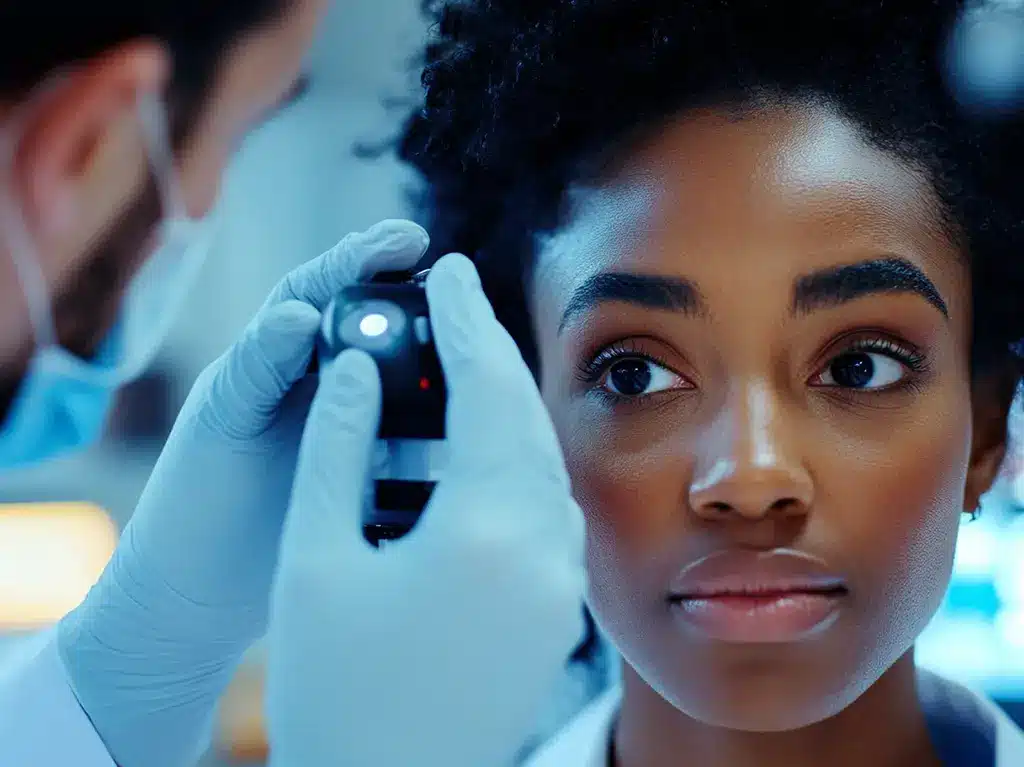
Annual full-body skin examinations by a dermatologist are one of the most effective tools for early detection. Because many at-risk areas are difficult to see without assistance, professional screening provides a level of thoroughness that self-examination alone cannot replicate. Black patients are encouraged to advocate for these screenings during primary care visits, especially if they have a personal or family history of skin cancer.

Why Skin Cancer Awareness Matters for African Americans

Skin cancer awareness for African Americans is not simply a public health talking point — it is a matter of survival. Data from the National Cancer Institute and the Centers for Disease Control and Prevention (CDC) consistently show that Black Americans are diagnosed with melanoma at later stages than white Americans, leading to significantly worse prognoses. Systemic factors, including limited access to dermatological care, underrepresentation in clinical research, and persistent myths, all contribute to this disparity.

Culturally competent medical education and community outreach are essential tools for changing these outcomes. When physicians, community health workers, and public campaigns use imagery and language that reflects the diversity of patients they serve, more people from underrepresented groups recognize themselves in health messaging and take preventive steps. Organizations such as the Melanoma Research Foundation and the AAD have increasingly prioritized inclusive education in their awareness campaigns.

Patients themselves play a powerful role as well. Learning to perform regular skin self-examinations, scheduling annual dermatologist visits, and speaking openly with family members about skin health can create a culture of prevention within communities. Melanoma myths in Black skin debunked through education allow individuals to make informed decisions about sun protection, screenings, and prompt medical consultations — all of which translate directly into better survival rates.

Myth Fact
Black people cannot get skin cancer. Black people can develop skin cancer; late diagnosis leads to worse outcomes.
Dark skin provides complete sun protection. Melanin offers limited UV protection roughly equivalent to SPF 13 — far below recommended levels.
Black people do not need sunscreen. Dermatologists recommend SPF 30+ broad-spectrum sunscreen for all skin tones.
Skin cancer always appears as a red or pink spot. On darker skin, it often appears as dark brown, black, or colorless patches, often in non-sun-exposed areas.
Skin cancer survival rates are the same for all races. Five-year melanoma survival rates for Black Americans have historically been lower due to later-stage diagnoses.

Frequently Asked Questions

Is skin cancer common in Black people?

Skin cancer is less frequent in Black individuals compared to white individuals, but it is not rare, and it is considerably more dangerous when it does occur. Black patients are more likely to be diagnosed at an advanced stage, which reduces treatment effectiveness and survival rates. Awareness and regular dermatological screenings are essential for improving early detection and outcomes in this population.

Where does melanoma typically appear on Black skin?

Melanoma in Black individuals most commonly develops in areas not typically exposed to the sun, including the palms, soles, under the nails, and in mucous membranes. This subtype, called acral lentiginous melanoma, is the most common form of melanoma in darker-skinned populations. Because these areas are often overlooked during standard skin checks, targeted self-examination and professional screenings are especially important.

What SPF should Black people use?

The American Academy of Dermatology recommends a broad-spectrum sunscreen with at least SPF 30 for all individuals, including those with darker skin tones. While melanin provides some natural UV protection, it is insufficient for long-term skin health. Daily sunscreen application — even on cloudy days — reduces cumulative UV damage, lowers skin cancer risk, and supports overall skin health for people of all complexions.

[EN] Cancer Types
Cancer Clinical Trial Options

Specialized matching specifically for oncology clinical trials and cancer care research.

Your Birthday


By filling out this form, you're consenting only to release your medical records. You're not agreeing to participate in clinical trials yet.

Massive Bio has onboarded over 160,000+ cancer patients to find their clinical trial

Most Recent Article