Differentiated Thyroid Cancer
Differentiated Thyroid Cancer refers to the most common types of thyroid cancer, originating from the follicular cells of the thyroid gland. Understanding this condition is crucial for effective management and improved patient outcomes.
Key Takeaways
- Differentiated Thyroid Cancer (DTC) is the most common form of thyroid cancer, originating from follicular cells.
- The primary types of differentiated thyroid cancer are papillary and follicular thyroid cancer.
- Differentiated thyroid cancer symptoms are often subtle, with a palpable lump in the neck being the most common sign.
- Diagnosis typically involves physical examination, imaging (ultrasound), and fine-needle aspiration biopsy.
- Differentiated thyroid cancer treatment options include surgery, radioactive iodine therapy, and sometimes external beam radiation or targeted therapy.
What is Differentiated Thyroid Cancer?
Differentiated Thyroid Cancer (DTC) is a group of thyroid cancers that develop from the follicular cells of the thyroid gland, which are responsible for producing thyroid hormones. These cancers are termed “differentiated” because their cells resemble normal thyroid cells under a microscope, making them generally less aggressive and more treatable than other forms of thyroid cancer. DTC accounts for approximately 95% of all thyroid cancer cases, making it the most prevalent type. According to the American Cancer Society, thyroid cancer incidence rates have been stable or slightly decreasing in recent years after rising for several decades, with an estimated 43,720 new cases in the U.S. in 2024. (Source: American Cancer Society).
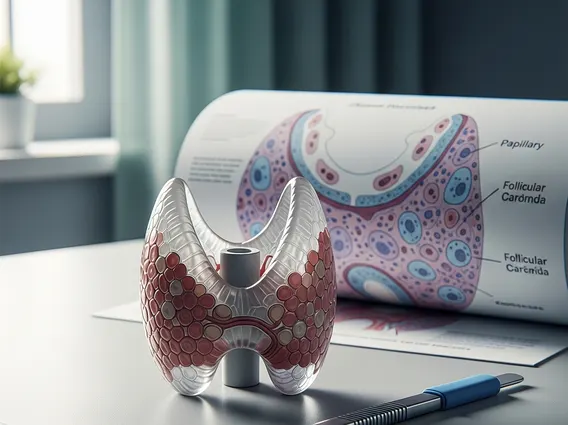
The primary types of differentiated thyroid cancer are papillary thyroid cancer and follicular thyroid cancer. Papillary thyroid cancer is the most common subtype, accounting for about 80-85% of all thyroid cancers. It often grows slowly and spreads to lymph nodes in the neck. Follicular thyroid cancer is less common, making up about 10-15% of cases, and tends to spread through the bloodstream to distant organs like the lungs or bones. Both types generally have a good prognosis, especially when detected early.
Symptoms and Diagnosis of Differentiated Thyroid Cancer
Many individuals with differentiated thyroid cancer symptoms may not experience any noticeable signs in the early stages. Often, the first indication is a lump or nodule in the neck that can be felt during a routine physical examination or discovered incidentally during imaging for another condition. While most thyroid nodules are benign, it is crucial to have any new or growing lump evaluated by a healthcare professional.
Other potential symptoms, though less common, can include:
- Difficulty swallowing or a feeling of pressure in the throat.
- Hoarseness or other voice changes that persist.
- Swollen lymph nodes in the neck.
- Pain in the neck, jaw, or ear.
Diagnosis typically begins with a physical examination of the neck and a review of medical history. If a nodule is found, an ultrasound of the thyroid is usually performed to assess its size, number, and characteristics. If the ultrasound suggests a suspicious nodule, a fine-needle aspiration (FNA) biopsy is conducted. During an FNA, a thin needle is used to collect cells from the nodule, which are then examined under a microscope by a pathologist to determine if cancer cells are present.
Differentiated Thyroid Cancer Treatment Options
The approach to differentiated thyroid cancer treatment is highly individualized, depending on the type and stage of cancer, as well as the patient’s overall health. The primary treatment for most DTC cases is surgery, often followed by other therapies.
Common treatment modalities include:
- Surgery: This is the cornerstone of DTC treatment. It typically involves a thyroidectomy, which can be either a total thyroidectomy (removal of the entire thyroid gland) or a lobectomy (removal of only the affected lobe). Lymph nodes in the neck may also be removed if cancer has spread.
- Radioactive Iodine (RAI) Therapy: After surgery, some patients receive RAI therapy. This treatment uses a radioactive form of iodine that is absorbed by any remaining thyroid tissue (including microscopic cancer cells) and destroys them, while sparing most other body tissues. It is particularly effective for DTC because thyroid cells are unique in their ability to absorb iodine.
- Thyroid Hormone Therapy: Following thyroidectomy, patients will need lifelong thyroid hormone replacement therapy (levothyroxine) to replace the hormones no longer produced by the thyroid gland. This therapy also helps suppress the growth of any remaining cancer cells by lowering thyroid-stimulating hormone (TSH) levels.
- External Beam Radiation Therapy: This is rarely used for DTC but may be considered for advanced cases where the cancer has spread to nearby structures and cannot be completely removed by surgery, or if RAI therapy is not effective.
- Targeted Therapy: For advanced or metastatic DTC that does not respond to standard treatments, targeted therapies may be used. These drugs specifically target molecular pathways involved in cancer growth and progression.
Regular follow-up care, including blood tests to monitor thyroid hormone levels and TSH, as well as imaging studies, is essential to detect any recurrence and manage long-term health. While alternative and complementary therapies may offer supportive care, they should not replace conventional medical treatment for Differentiated Thyroid Cancer.