
Laser Interstitial Thermal Therapy
Laser Interstitial Thermal Therapy (LITT) is a cutting-edge, minimally invasive neurosurgical procedure that employs precisely directed laser energy to treat various neurological conditions. This advanced technique offers a targeted approach to destroying abnormal tissue while minimizing impact on surrounding healthy areas.
Key Takeaways
- Laser Interstitial Thermal Therapy (LITT) is a minimally invasive procedure that uses laser heat to destroy targeted abnormal tissue.
- It is guided by real-time Magnetic Resonance Imaging (MRI) for extreme precision.
- Commonly used for treating brain tumors, epilepsy, and other neurological lesions.
- Benefits include smaller incisions, reduced pain, shorter hospital stays, and faster recovery compared to traditional open surgery.
- LITT offers a highly targeted treatment option, preserving healthy tissue and reducing risks.
What is Laser Interstitial Thermal Therapy (LITT)?
Laser Interstitial Thermal Therapy (LITT) is a sophisticated medical procedure that utilizes laser energy to thermally ablate, or destroy, targeted tissue within the body. Primarily used in neurosurgery, this technique is particularly valuable for treating conditions such as certain brain tumors, radiation necrosis, and epilepsy foci that are difficult to access with conventional surgery or where a less invasive approach is preferred. The process involves inserting a thin fiber optic laser probe directly into the target area, which then delivers heat to destroy the abnormal cells.
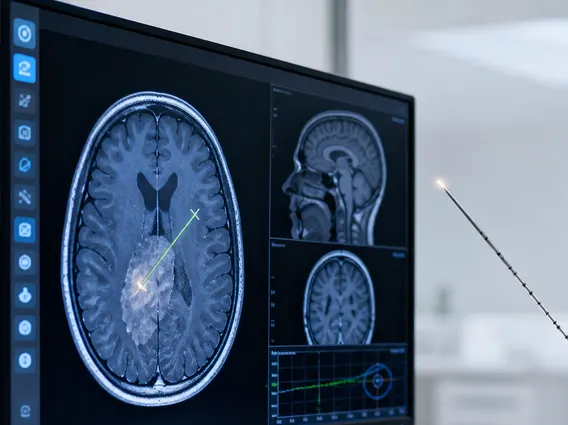
The mechanism of Laser Interstitial Thermal Therapy explained involves the precise application of heat. Under continuous real-time Magnetic Resonance Imaging (MRI) guidance, clinicians can accurately monitor the temperature changes in the tissue, ensuring that only the intended area is treated while minimizing damage to adjacent healthy structures. This precision makes LITT a powerful tool for neurosurgeons seeking to offer effective treatment with reduced invasiveness.
Procedure Details for Laser Interstitial Thermal Therapy
The process for Laser Interstitial Thermal Therapy procedure details a meticulous, multi-step approach designed for precision and patient safety. Initially, advanced imaging, typically MRI, is used to map the exact location and dimensions of the target lesion. This detailed planning ensures accurate trajectory for the laser probe.
During the procedure, a small incision, often no larger than a few millimeters, is made in the scalp, and a tiny burr hole is created in the skull. Through this opening, a thin, flexible fiber optic laser probe is carefully guided into the target tissue. The placement of the probe is continuously verified using real-time MRI, which also provides thermal mapping to monitor the temperature of the tissue during ablation. Once the probe is correctly positioned, the laser is activated, delivering controlled heat to destroy the abnormal cells. The MRI guidance allows the surgeon to visualize the extent of the thermal lesion as it forms, ensuring complete ablation of the target while protecting surrounding critical structures. After the ablation is complete, the laser probe is removed, and the small incision is closed, often requiring only a single stitch.
Key steps in the LITT procedure include:
- Pre-operative imaging and planning for precise target localization.
- Creation of a minimal incision and burr hole.
- Stereotactic insertion of the fiber optic laser probe under MRI guidance.
- Real-time thermal monitoring via MRI during laser activation.
- Controlled ablation of the target tissue.
- Removal of the probe and closure of the incision.
Benefits of Laser Interstitial Thermal Therapy
The Benefits of Laser Interstitial Thermal Therapy are significant, particularly when compared to traditional open surgical techniques. As a minimally invasive procedure, LITT typically results in smaller incisions, which translates to less post-operative pain and a reduced risk of infection. Patients often experience shorter hospital stays and a faster overall recovery period, allowing them to return to their normal activities more quickly.
One of the most compelling advantages of LITT is its precision. The real-time MRI guidance allows for highly targeted treatment, ensuring that the laser energy is delivered specifically to the abnormal tissue while minimizing damage to healthy brain tissue. This precision is crucial for treating lesions located in eloquent areas of the brain, where preserving neurological function is paramount. Furthermore, LITT can be an option for patients who may not be candidates for conventional open surgery due to the location of their lesion, their overall health, or previous treatments. This innovative approach expands treatment possibilities for many individuals facing complex neurological conditions.



















