
Clivus
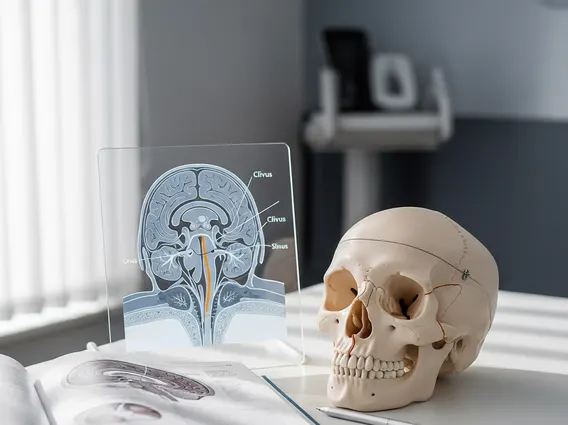
The clivus is a crucial anatomical structure located at the base of the skull, formed by the fusion of two major bones. Its strategic position makes it vital for supporting the brainstem and housing important neurovascular structures.
Key Takeaways
- The Clivus is a bony slope at the skull base, formed by the sphenoid and occipital bones.
- It provides structural support for the brainstem and parts of the cerebellum.
- Its location is anterior to the foramen magnum, behind the sphenoid sinus.
- The clivus is a key landmark in neurosurgery and imaging due to its proximity to vital neural structures.
What is the Clivus?
The Clivus refers to a smooth, sloping bony surface located on the internal base of the skull. This structure is formed by the junction of two cranial bones: the posterior part of the sphenoid bone and the anterior part of the occipital bone. Its name, derived from the Latin word for “slope,” accurately describes its characteristic incline. From a clivus medical definition perspective, it is a significant landmark for neurosurgeons and radiologists due to its close relationship with the brainstem, specifically the pons and medulla oblongata, and various cranial nerves and blood vessels.
Understanding what is the clivus bone is essential for comprehending the complex anatomy of the skull base. It serves as a protective shield for critical neurological components, forming the posterior wall of the sphenoid sinus and the anterior boundary of the posterior cranial fossa. Its robust nature contributes to the overall stability of the skull base, safeguarding the delicate structures it encloses.
Clivus Anatomy, Location, and Function
The clivus anatomy and function are intrinsically linked to its position at the central base of the skull. Anatomically, it is a broad, shallow depression that slopes downwards and backwards from the dorsum sellae (part of the sphenoid bone) to the anterior margin of the foramen magnum (the large opening at the base of the skull where the spinal cord exits). This unique configuration makes the clivus location in skull a critical area, as it lies directly anterior to the brainstem, which contains vital centers for breathing, heart rate, and consciousness.
Functionally, the clivus primarily serves as a protective bony structure for the brainstem and the basilar artery, a major blood vessel supplying the brain. It also provides attachment points for several ligaments and muscles that contribute to the stability of the craniocervical junction. Its smooth surface facilitates the passage of the brainstem without undue pressure or friction. The clivus is also a common site for certain types of tumors, such as chordomas and chondrosarcomas, making its detailed anatomical understanding crucial for diagnosis and surgical planning.
Key anatomical relations of the Clivus include:
- Superiorly: Abuts the dorsum sellae of the sphenoid bone.
- Inferiorly: Merges with the anterior rim of the foramen magnum.
- Anteriorly: Forms the posterior wall of the sphenoid sinus.
- Posteriorly: Lies immediately anterior to the brainstem (pons and medulla oblongata).
- Laterally: Related to the petrous parts of the temporal bones.
Given its central and protective role, any pathology affecting the clivus can have significant neurological implications, underscoring its importance in both normal physiological function and clinical contexts.



















