
Nonmelanoma Skin Cancer
Nonmelanoma skin cancer refers to a group of cancers that develop in the skin cells other than melanocytes, which are the cells that produce pigment. It is the most common form of cancer globally, primarily affecting areas of the skin exposed to the sun.
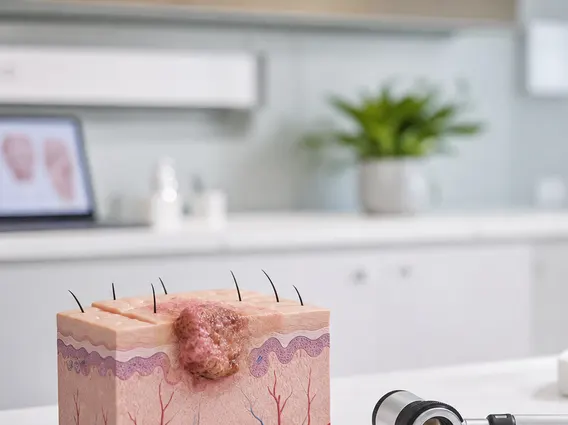
Key Takeaways
- Nonmelanoma Skin Cancer is the most common type of cancer, originating in the basal or squamous cells of the skin.
- The two primary types are Basal Cell Carcinoma (BCC) and Squamous Cell Carcinoma (SCC), both linked to UV exposure.
- Symptoms vary but often include new growths, sores that don’t heal, or changes in existing skin lesions.
- Early detection is crucial for effective treatment, which commonly involves surgical removal or other localized therapies.
- Prevention through sun protection is the most effective strategy against developing nonmelanoma skin cancer.
What is Nonmelanoma Skin Cancer?
Nonmelanoma Skin Cancer is a broad term for cancers that arise from the basal cells or squamous cells, which are the main cell types in the epidermis (the outermost layer of the skin). Unlike melanoma, which originates from pigment-producing melanocytes, nonmelanoma skin cancers typically grow more slowly and are less likely to spread to other parts of the body, though they can be locally destructive if left untreated. According to the American Academy of Dermatology, approximately 3.6 million cases of basal cell carcinoma and 1.8 million cases of squamous cell carcinoma are diagnosed annually in the United States, making them the most prevalent cancers.
These cancers are primarily caused by cumulative exposure to ultraviolet (UV) radiation from sunlight or tanning beds. While often curable, early detection and treatment are vital to prevent potential disfigurement and reduce the risk of recurrence or, in rare cases, metastasis.
Types and Symptoms of Nonmelanoma Skin Cancer
The two most common types of nonmelanoma skin cancer are Basal Cell Carcinoma (BCC) and Squamous Cell Carcinoma (SCC). BCC is the most frequently diagnosed type, often appearing as a pearly or waxy bump, or a flat, flesh-colored or brown scar-like lesion. It typically grows slowly and rarely spreads.
SCC is the second most common type and can present as a firm, red nodule or a flat lesion with a scaly, crusted surface. While more aggressive than BCC, it is still highly treatable when caught early. Other less common types include Merkel cell carcinoma and sebaceous gland carcinoma.
Recognizing nonmelanoma skin cancer symptoms is key for early diagnosis. Common warning signs include:
- A new skin growth that is persistent and does not heal within a few weeks.
- A sore that bleeds, oozes, or crusts and remains open for an extended period.
- A reddish patch or irritated area, especially on the chest, shoulders, arms, or legs.
- A shiny bump or nodule that is pearly or translucent, often appearing on the head, neck, or trunk.
- A flat, scaly patch with a raised border, which may be brown or flesh-colored.
Any suspicious changes to the skin should be promptly evaluated by a dermatologist.
Nonmelanoma Skin Cancer Treatment Options
The approach to nonmelanoma skin cancer treatment is highly individualized, depending on the type, size, location, and depth of the cancer, as well as the patient’s overall health. The primary goal is to remove the cancer completely while preserving as much healthy tissue as possible and minimizing scarring.
Common treatment modalities include:
| Treatment Method | Description | Common Use Cases |
|---|---|---|
| Surgical Excision | The tumor and a small margin of healthy tissue are cut out. | Most BCCs and SCCs, especially smaller ones. |
| Mohs Surgery | Layers of cancer-containing skin are progressively removed and examined until only cancer-free tissue remains. | Cancers on the face, recurrent cancers, or larger tumors. |
| Curettage and Electrodessication | The cancer is scraped off with a curette, and the base is burned with an electric needle. | Superficial BCCs and SCCs. |
| Radiation Therapy | High-energy beams are used to kill cancer cells. | Patients who cannot undergo surgery, or for tumors in difficult-to-treat areas. |
| Cryotherapy | Liquid nitrogen is used to freeze and destroy superficial cancer cells. | Small, superficial nonmelanoma skin cancers. |
| Topical Medications | Creams or gels applied directly to the skin to destroy cancer cells. | Very superficial cancers, such as some BCCs and actinic keratoses. |
Following treatment, regular follow-up appointments are essential to monitor for recurrence and detect any new skin cancers. Prevention, primarily through consistent sun protection, remains the most effective strategy to reduce the risk of developing nonmelanoma skin cancer.



















