Abr Test
The Auditory Brainstem Response (ABR) test is a vital diagnostic tool used to assess the auditory pathway, from the inner ear to the brainstem. This non-invasive procedure helps identify hearing loss and neurological conditions, particularly in individuals who cannot participate in traditional behavioral hearing tests.
Key Takeaways
- The ABR test measures the brain’s electrical activity in response to sounds, evaluating the auditory pathway.
- It is particularly useful for infants, young children, and individuals unable to respond voluntarily to hearing tests.
- The procedure involves placing electrodes on the head and delivering sounds through headphones or earphones.
- The test is non-invasive, painless, and typically requires the patient to be still or asleep for accurate results.
- Results help diagnose the type and degree of hearing loss and assess the integrity of the auditory nerve and brainstem.
What is an ABR Test (Auditory Brainstem Response)?
An Auditory Brainstem Response (ABR) test, also known as a Brainstem Auditory Evoked Response (BAER) test, is an objective neurophysiological test that measures how the auditory nerve and brainstem respond to sound. This test records the electrical activity generated by the auditory system in response to specific sound stimuli, providing crucial information about the integrity of the hearing pathway.
The purpose of ABR test is primarily to determine hearing sensitivity in individuals who cannot provide reliable behavioral responses, such as newborns, infants, young children, or adults with developmental delays or cognitive impairments. It can also be used to diagnose retrocochlear lesions, such as acoustic neuromas, which affect the auditory nerve or brainstem. According to the World Health Organization (WHO), around 34 million children worldwide live with disabling hearing loss, underscoring the importance of early and accurate diagnostic tools like the ABR test for timely intervention.
The ABR test measures the latency and amplitude of a series of waves that occur within the first 10 milliseconds after a sound stimulus. These waves correspond to the sequential activation of different structures along the auditory pathway, including the cochlea, auditory nerve, and various nuclei within the brainstem. By analyzing these wave patterns, audiologists and physicians can infer the presence, type, and severity of hearing loss, as well as identify potential neurological issues affecting the auditory system.
ABR Test Procedure and What to Expect
The ABR test procedure is straightforward and non-invasive, typically lasting between 30 minutes to two hours, depending on the patient’s cooperation and the specific diagnostic needs. Preparation usually involves ensuring the patient is calm, quiet, or asleep, especially for infants and young children, as movement and muscle activity can interfere with the electrical recordings. Sometimes, mild sedation may be used for older children or adults who find it difficult to remain still.
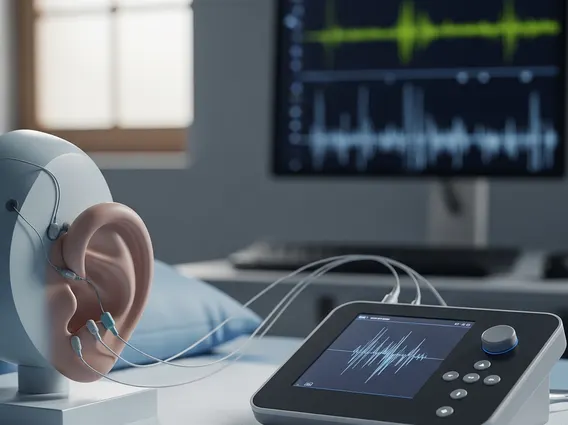
During the test, small electrodes are placed on the patient’s scalp (usually on the forehead and behind the ears, on the mastoid bones). These electrodes are connected to a computer that records the brain’s electrical activity. Soft earphones or small insert earbuds are placed in the patient’s ears, through which a series of clicking sounds or tone bursts are delivered. These sounds are presented at varying intensities and frequencies.
The computer then averages the brain’s responses to thousands of these sounds, filtering out background electrical noise to reveal the distinct ABR waveforms. The audiologist analyzes these waveforms to determine the lowest intensity at which a clear response is observed, which indicates the patient’s hearing threshold. This process helps in providing a comprehensive ABR hearing test explained result, detailing the functional status of the auditory system. The test is painless and poses no risks, making it a safe and reliable method for assessing hearing function across all age groups.