Epithelial
Epithelial tissue is a fundamental type of animal tissue that forms the covering of all body surfaces, lines body cavities and hollow organs, and is the major tissue in glands. It plays a crucial role in protecting the body, regulating substance movement, and facilitating various physiological processes.
Key Takeaways
- Epithelial tissue covers body surfaces, lines internal organs, and forms glands, acting as a protective barrier and facilitating various bodily functions.
- It is characterized by tightly packed cells, a basement membrane, and an avascular nature, meaning it lacks direct blood supply.
- Epithelial cells are classified by their shape (squamous, cuboidal, columnar) and the number of layers (simple, stratified, pseudostratified).
- Key functions include protection from injury and pathogens, secretion of substances like hormones and mucus, absorption of nutrients, and filtration of waste.
- These tissues are found throughout the body, from the outer layer of the skin to the lining of the digestive tract, respiratory passages, and urinary system.
What is Epithelial Tissue?
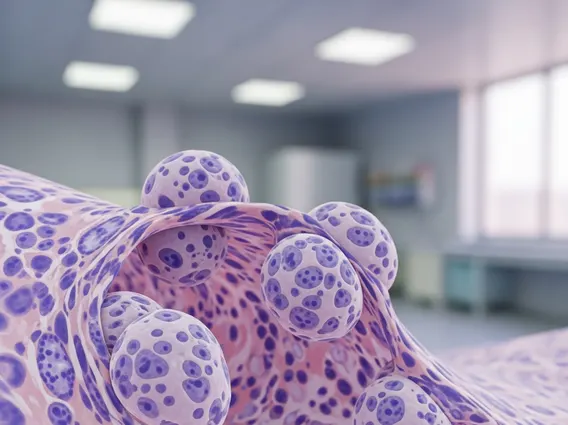
Epithelial tissue is one of the four basic types of animal tissue, alongside connective, muscle, and nervous tissues. It is composed of closely packed cells that form continuous sheets, creating protective barriers and functional linings throughout the body. A defining characteristic of epithelial tissue is its polarity, meaning it has an apical surface exposed to the external environment or internal body cavity, and a basal surface attached to an underlying basement membrane.
This tissue is unique because it is avascular, meaning it does not have its own direct blood supply. Instead, it receives nutrients by diffusion from the underlying connective tissue. The cells are held together by specialized cell junctions, such as tight junctions, desmosomes, and gap junctions, which enable them to form strong, cohesive layers. These structural features allow epithelial tissue to perform its diverse roles effectively, from forming the outer layer of the skin to lining the intricate structures of internal organs.
Types of Epithelial Cells and Their Locations
The classification of epithelial cells is primarily based on two criteria: the shape of the cells and the number of cell layers. These variations dictate the specific roles and locations where is epithelial tissue found throughout the body. Understanding these types helps to appreciate the specialized functions each performs.
Epithelial cells can be broadly categorized by their shape:
- Squamous cells: These are flat, thin, and scale-like, ideal for diffusion and filtration.
- Cuboidal cells: Cube-shaped with spherical nuclei, often involved in secretion and absorption.
- Columnar cells: Tall, column-shaped cells with oval nuclei usually located near the basal surface, specialized for secretion and absorption, often featuring cilia or microvilli.
Based on the number of layers, epithelial tissue can be:
- Simple epithelium: Consists of a single layer of cells, facilitating absorption, secretion, and filtration.
- Stratified epithelium: Composed of multiple layers of cells, primarily serving a protective function in areas subject to abrasion.
- Pseudostratified epithelium: Appears stratified due to nuclei being at different levels, but all cells are attached to the basement membrane, making it a single layer. Often ciliated, found in the respiratory tract.
The following table illustrates common types of epithelial tissue, their characteristics, and typical locations:
| Type of Epithelial Tissue | Cell Shape & Layers | Primary Location |
|---|---|---|
| Simple Squamous | Single layer, flat cells | Lining of blood vessels (endothelium), air sacs of lungs (alveoli), kidney glomeruli |
| Simple Cuboidal | Single layer, cube-shaped cells | Kidney tubules, ducts and secretory portions of small glands, ovary surface |
| Simple Columnar | Single layer, tall cells | Lining of the gastrointestinal tract (stomach to rectum), gallbladder |
| Stratified Squamous | Multiple layers, flat cells on top | Epidermis of the skin, lining of esophagus, mouth, vagina |
| Pseudostratified Columnar | Single layer, varying heights, often ciliated | Lining of the trachea and most of the upper respiratory tract |
| Transitional | Multiple layers, cells change shape when stretched | Lining of the urinary bladder, ureters, part of the urethra |
Key Functions of Epithelial Tissue
The diverse structures and locations of epithelial tissue enable it to perform a wide array of vital functions essential for the body’s survival and homeostasis. The primary function of epithelial tissue includes protection, secretion, absorption, filtration, and sensory reception.
One of its most critical roles is protection. For example, the stratified squamous epithelium of the skin forms a robust barrier against physical abrasion, chemical damage, and microbial invasion. Similarly, epithelial linings protect internal organs from pathogens and harmful substances. Another significant function is secretion, where glandular epithelium forms glands that produce and release substances like hormones, enzymes, mucus, and sweat, crucial for digestion, metabolism, and temperature regulation.
Absorption is prominently seen in the simple columnar epithelium lining the small intestine, which is specialized with microvilli to maximize surface area for nutrient uptake from digested food. In the kidneys, simple squamous epithelium facilitates filtration, allowing waste products to be removed from the blood while retaining essential molecules. Lastly, specialized epithelial cells contribute to sensory reception, such as those found in the taste buds, olfactory epithelium, and inner ear, enabling the body to perceive its environment.