Capillary
Capillaries are the smallest and most numerous blood vessels in the human body, forming a vital network that connects arterioles and venules. Their primary role is to facilitate the exchange of essential substances between the blood and surrounding tissues.
Key Takeaways
- Capillaries are microscopic blood vessels that form the bridge between the arterial and venous systems.
- They possess extremely thin walls, typically one cell thick, which is crucial for efficient substance exchange.
- Their main function is to allow the transfer of oxygen, nutrients, hormones, and waste products between blood and tissue cells.
- There are three primary types of capillaries: continuous, fenestrated, and sinusoidal, each adapted for specific functions and locations.
- The extensive network of capillaries ensures that virtually every cell in the body is within a short distance of a blood supply.
What is a Capillary?
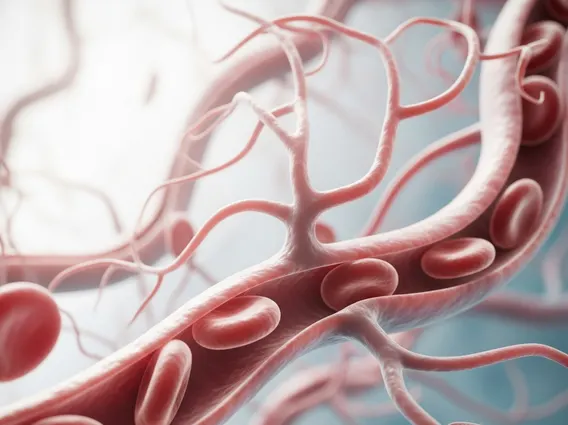
A Capillary is a minute blood vessel that forms part of the microcirculation, connecting arterioles (small arteries) to venules (small veins). These vessels are so narrow that red blood cells often have to pass through them in single file. Their extensive network, known as a capillary bed, permeates nearly all tissues and organs, ensuring that every cell in the body is in close proximity to a blood supply. This intricate system is fundamental for the delivery of oxygen and nutrients and the removal of metabolic waste products, making capillaries indispensable for life.
Capillary Structure, Characteristics, and Types
The unique capillary structure and characteristics are perfectly adapted for their exchange function. Each capillary wall consists of a single layer of endothelial cells, surrounded by a thin basement membrane. This extreme thinness, typically only 0.5 micrometers, minimizes the diffusion distance for substances moving between blood and tissue. Unlike larger blood vessels, capillaries lack the layers of smooth muscle and elastic tissue, which allows for greater permeability and flexibility.
There are three main types of capillaries, each distinguished by variations in their endothelial lining and the presence of intercellular junctions, which dictate their permeability:
- Continuous Capillaries: These are the most common type, characterized by an uninterrupted endothelial lining with tight junctions between cells. They are found in tissues like muscle, skin, lungs, and the central nervous system, where they form the blood-brain barrier, restricting the passage of many substances.
- Fenestrated Capillaries: These capillaries have pores, or fenestrations, in their endothelial cells, which allow for rapid passage of fluids and small solutes. They are typically found in organs involved in filtration and absorption, such as the kidneys, small intestine, and endocrine glands.
- Sinusoidal Capillaries (Sinusoids): These are the least common and most permeable type, featuring larger lumens, incomplete basement membranes, and large gaps between endothelial cells. This structure permits the passage of large molecules and even blood cells, making them crucial in organs like the liver, spleen, and bone marrow.
Capillary Function in the Body
The primary capillary function in the body is to facilitate the exchange of substances between the blood and the interstitial fluid surrounding the cells. This critical process ensures that tissues receive the necessary resources and that metabolic byproducts are efficiently removed. Oxygen, nutrients (like glucose and amino acids), and hormones diffuse from the blood, across the thin capillary walls, and into the tissue cells. Conversely, carbon dioxide, urea, and other waste products move from the tissue cells into the capillaries to be transported away for excretion.
This exchange occurs through several mechanisms, including diffusion (for gases and small solutes), filtration (movement of fluid out of the capillary at the arterial end due to hydrostatic pressure), and reabsorption (movement of fluid back into the capillary at the venous end due to osmotic pressure). The vast surface area provided by the extensive capillary network, estimated to be around 500-700 square meters in an adult, maximizes the efficiency of these exchange processes, playing a crucial role in maintaining overall physiological homeostasis.