
Fulguration
Fulguration is a medical procedure that utilizes high-frequency electrical current to destroy superficial tissue, commonly employed in various surgical and dermatological contexts. It is a precise technique for managing certain lesions and achieving hemostasis.
Key Takeaways
- Fulguration is a medical procedure that uses high-frequency electrical current to superficially destroy tissue.
- It works by delivering an electrical spark that desiccates and carbonizes the target tissue without direct contact.
- Common uses include treating benign and some superficial malignant skin lesions, as well as achieving hemostasis during surgery.
- Potential risks involve scarring, infection, and incomplete tissue removal.
- Fulguration differs from electrocautery primarily in its mechanism of action and depth of tissue effect.
What is Fulguration: Medical Procedure and Mechanism
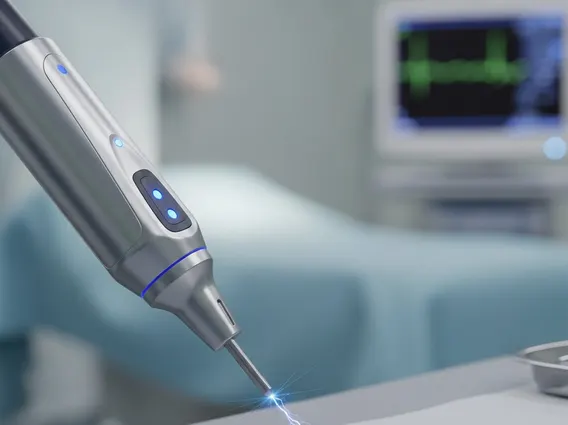
Fulguration is a medical procedure that involves the application of a high-frequency electrical current to achieve superficial tissue destruction. This technique is a form of electrodessication, where an electrical spark is generated between an electrode and the target tissue without direct contact. The term “what is Fulguration” refers to this process of using electrical energy to desiccate and carbonize tissue, leading to its removal or destruction.
The mechanism of how does fulguration work in surgery involves a specialized electrosurgical unit. This unit generates a high-voltage, low-amperage, high-frequency alternating current. When the electrode is held a short distance from the tissue, an electrical arc, or spark, jumps from the electrode to the tissue. This spark rapidly heats the surface cells, causing intracellular water to vaporize and the cells to dehydrate and carbonize. Because the current is delivered in a non-contact manner and is relatively superficial, it creates a localized effect, making it suitable for treating lesions on the skin or mucous membranes.
Fulguration Treatment: Uses, Risks, and Electrocautery Comparison
Fulguration treatment uses and risks are important considerations for clinicians and patients. This procedure is widely used in dermatology, urology, and other surgical specialties for various applications. Common uses include the removal of benign skin lesions such as warts, skin tags, and seborrheic keratoses. It is also effective for treating certain superficial malignant lesions, like basal cell carcinomas, especially when combined with curettage. Furthermore, fulguration is frequently employed for achieving hemostasis (stopping bleeding) during surgical procedures, particularly in areas with diffuse capillary oozing.
Despite its effectiveness, fulguration carries potential risks. These can include scarring, which may be more pronounced depending on the treated area and individual healing. There is also a risk of infection, although this is generally low with proper aseptic technique. Pain and discomfort during and after the procedure are common, typically managed with local anesthesia. In some cases, incomplete removal of the lesion may occur, necessitating further treatment. It is crucial for patients to discuss these potential risks with their healthcare provider.
Understanding fulguration vs electrocautery explained is key to appreciating their distinct applications. While both techniques use electricity, their mechanisms and effects on tissue differ significantly. Electrocautery involves direct contact of a heated electrode with tissue, causing thermal damage through conduction. It typically results in more precise cutting and coagulation, often achieving deeper tissue effects. Fulguration, conversely, uses a non-contact spark to desiccate and carbonize, leading to more superficial tissue destruction. The following table highlights their primary differences:
| Feature | Fulguration | Electrocautery |
|---|---|---|
| Mechanism | Non-contact electrical spark; superficial desiccation/carbonization | Direct contact of heated electrode; thermal damage by conduction |
| Tissue Effect | Superficial destruction, wide area of effect | Precise cutting, coagulation, deeper tissue effect |
| Current Type | High voltage, low amperage, high frequency (damped waveform) | Low voltage, high amperage (continuous waveform) |
| Primary Uses | Benign lesion removal, superficial malignant lesions, hemostasis | Surgical cutting, precise coagulation, deep tissue ablation |



















