
Immunofluorescence
Immunofluorescence (IF) is a widely used laboratory technique that leverages the specificity of antibodies to detect the presence of antigens in biological samples. This method is fundamental in diagnostic pathology and biomedical research, allowing for the visualization of specific cellular components or pathogens.
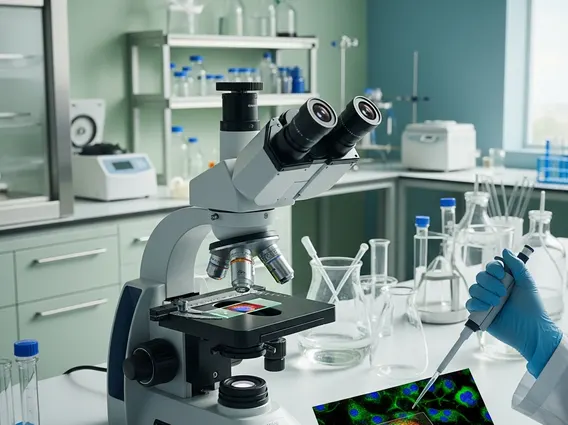
Key Takeaways
- Immunofluorescence (IF) is a technique that uses fluorescently labeled antibodies to visualize specific antigens in cells or tissues.
- It is a powerful tool for detecting proteins, pathogens, and other molecules with high specificity and sensitivity.
- The two primary methods are direct vs indirect immunofluorescence, differing in how the fluorescent tag is applied to the antibody.
- Applications of immunofluorescence are broad, including disease diagnosis, research into cellular processes, and pathogen detection.
- The technique relies on immunofluorescence microscopy explained through the use of a fluorescence microscope to observe the emitted light.
What is Immunofluorescence (IF)?
Immunofluorescence (IF) is a laboratory technique that utilizes fluorescent dyes to visualize specific target antigens within cells or tissues. This method relies on the principle that antibodies can bind with high specificity to their corresponding antigens. By attaching a fluorochrome (a fluorescent dye) to an antibody, researchers and clinicians can detect and localize the antigen under a fluorescence microscope. When excited by light of a specific wavelength, the fluorochrome emits light at a longer wavelength, revealing the antigen’s location.
The process of immunofluorescence microscopy explained involves several key steps. First, a biological sample (such as a tissue section or cell culture) is prepared. Then, antibodies, either directly conjugated with a fluorochrome or unconjugated for subsequent binding by a fluorescent secondary antibody, are applied to the sample. After incubation and washing, the sample is observed using a fluorescence microscope, which illuminates the fluorochrome and captures the emitted light, creating a visual map of the antigen’s distribution. This technique is invaluable for understanding cellular structures, identifying pathogens, and diagnosing various diseases.
Direct vs. Indirect Immunofluorescence Techniques
The field of immunofluorescence primarily employs two distinct approaches: direct and indirect methods. Understanding the differences between direct vs indirect immunofluorescence is crucial for selecting the appropriate technique for specific diagnostic or research goals. Both methods rely on the antigen-antibody interaction but differ in their antibody labeling strategy and sensitivity.
In direct immunofluorescence, the primary antibody, which is specific to the target antigen, is directly conjugated with a fluorochrome. This labeled primary antibody binds directly to the antigen in the sample. This method is generally faster due to fewer incubation steps and minimizes potential cross-reactivity from secondary antibodies. However, its sensitivity can be lower because only one fluorochrome molecule binds per antigen site.
Conversely, indirect immunofluorescence involves two antibodies. An unlabeled primary antibody first binds to the target antigen. Then, a fluorescently labeled secondary antibody, which is specific to the primary antibody, binds to the primary antibody. This method offers significantly higher sensitivity because multiple secondary antibodies can bind to a single primary antibody, amplifying the fluorescent signal. While it requires an additional incubation step, indirect immunofluorescence is often preferred for its enhanced signal detection and flexibility, as a single labeled secondary antibody can be used with various unlabeled primary antibodies from the same host species.
| Feature | Direct Immunofluorescence | Indirect Immunofluorescence |
|---|---|---|
| Antibodies Used | One (labeled primary antibody) | Two (unlabeled primary, labeled secondary) |
| Sensitivity | Lower | Higher (signal amplification) |
| Procedure Time | Faster (fewer steps) | Slower (more steps) |
| Specificity | High | High |
| Flexibility | Lower (each primary antibody needs labeling) | Higher (one labeled secondary for multiple primaries) |
Applications of Immunofluorescence Microscopy
The applications of immunofluorescence microscopy are extensive and span across various disciplines, including clinical diagnostics, immunology, cell biology, and microbiology. Its ability to precisely localize specific molecules within complex biological samples makes it an indispensable tool for both routine analysis and cutting-edge research.
In clinical settings, immunofluorescence is crucial for diagnosing autoimmune diseases, infectious diseases, and certain cancers. For instance, it is used to detect autoantibodies in conditions like systemic lupus erythematosus or pemphigus, where antibodies target the body’s own tissues. It also plays a vital role in identifying viral, bacterial, or parasitic infections by detecting specific pathogen antigens in patient samples. In oncology, IF can help characterize tumor cells by identifying specific biomarkers, aiding in prognosis and treatment selection.
Beyond diagnostics, immunofluorescence is a cornerstone of biomedical research. Researchers use it to:
- Map the distribution of proteins within cells and tissues.
- Study cell signaling pathways and protein-protein interactions.
- Monitor cellular processes such as cell division, migration, and differentiation.
- Investigate the effects of drugs or genetic manipulations on cellular components.
- Identify and characterize different cell types in mixed populations.
The versatility and high resolution of immunofluorescence microscopy continue to make it a powerful technique for advancing our understanding of health and disease at a molecular and cellular level.



















