
Stereotactic Biopsy
Stereotactic biopsy is a precise diagnostic procedure used to obtain tissue samples from suspicious areas within the body, most commonly in the breast or brain. This minimally invasive technique utilizes advanced imaging guidance to pinpoint the exact location of an abnormality, allowing for accurate diagnosis without the need for open surgery.
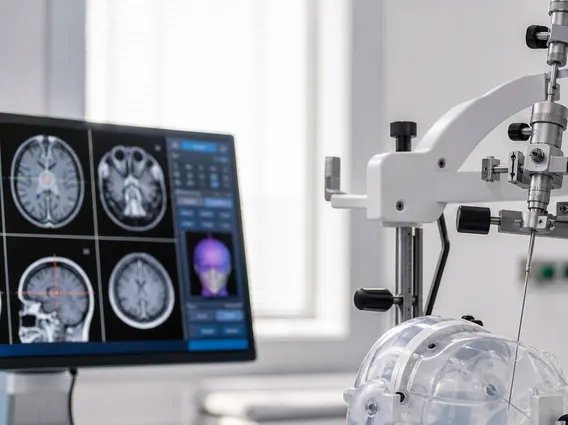
Key Takeaways
- Stereotactic Biopsy is a minimally invasive procedure using imaging to guide a needle to a suspicious lesion for tissue sampling.
- It is often performed for breast abnormalities detected on mammograms or other imaging, as well as for certain brain lesions.
- The procedure involves precise localization, local anesthesia, and the collection of small tissue samples for pathological analysis.
- Benefits include high accuracy, reduced invasiveness compared to surgical biopsy, and a quicker recovery time.
- Potential risks are generally minor, such as bruising or bleeding, with a straightforward recovery process.
What Is Stereotactic Biopsy?
Stereotactic Biopsy refers to a diagnostic medical procedure that uses a computer and imaging equipment to create a three-dimensional map of a target area, typically a suspicious lesion, to guide a biopsy needle. This technique is highly effective for sampling abnormalities that are too small to be felt during a physical exam or are located in difficult-to-reach areas. It is frequently employed in breast cancer diagnosis when a suspicious mass, calcification, or architectural distortion is identified on a mammogram, MRI, or ultrasound, but cannot be easily accessed by other biopsy methods.
The primary goal of a stereotactic biopsy is to determine whether an abnormal growth is benign (non-cancerous) or malignant (cancerous). By obtaining a small tissue sample, pathologists can examine the cells under a microscope to make a definitive diagnosis. This precision helps avoid unnecessary surgical procedures for benign conditions while ensuring timely treatment for malignant ones. According to the American Cancer Society, stereotactic breast biopsy is a common and effective method for diagnosing breast abnormalities, often providing results with high accuracy.
The Stereotactic Biopsy Procedure: What to Expect
The stereotactic biopsy procedure explained involves several key steps to ensure accuracy and patient comfort. Before the procedure, patients typically receive specific instructions, which may include avoiding certain medications like blood thinners. Upon arrival, the patient is positioned on a special table, usually lying face down with the breast positioned through an opening, or in another position suitable for the target area (e.g., for brain biopsies, the head is stabilized). The area to be biopsied is then thoroughly cleaned, and a local anesthetic is administered to numb the skin and deeper tissues, ensuring the patient remains comfortable throughout the process.
Using imaging guidance—most commonly mammography for breast biopsies, but sometimes MRI or CT for other areas like the brain—the physician precisely locates the target lesion. A small incision, typically a few millimeters, is made in the skin, and a hollow biopsy needle is inserted through this incision, guided by the imaging system to the exact coordinates of the abnormality. Multiple tissue samples are then collected using a vacuum-assisted device or a core needle. Once sufficient samples are obtained, a small marker clip may be placed at the biopsy site to facilitate future identification if needed. The needle is removed, pressure is applied to stop any bleeding, and the incision is covered with a sterile dressing. The entire procedure typically takes about 30 to 60 minutes.
Risks, Benefits, and Recovery After Stereotactic Biopsy
Understanding the stereotactic biopsy risks and benefits is crucial for patients. The benefits of this procedure are significant, including its minimally invasive nature, which means smaller incisions, less pain, and a quicker recovery compared to open surgical biopsies. It offers high diagnostic accuracy, often eliminating the need for more extensive surgery if the lesion is benign. Furthermore, it is typically performed on an outpatient basis, allowing patients to return home the same day.
While generally safe, there are some potential risks associated with stereotactic biopsy. These are usually minor and may include:
- Bruising or swelling at the biopsy site.
- Mild pain or discomfort.
- Bleeding, which is usually minimal.
- Infection, though rare, can occur.
- A small risk of pneumothorax (collapsed lung) if the biopsy is near the chest wall.
- In very rare cases, a false negative result, meaning the biopsy does not detect cancer that is actually present.
The stereotactic biopsy recovery process is generally straightforward. Patients are usually advised to apply ice packs to the biopsy site to minimize swelling and bruising. Over-the-counter pain relievers can help manage any discomfort. Strenuous activities, heavy lifting, and showering may be restricted for a day or two. It is important to keep the biopsy site clean and dry. Most individuals can resume their normal daily activities within 24 to 48 hours. Patients will receive specific post-procedure instructions and information on when to expect their biopsy results, which are typically available within a few days. Any signs of excessive bleeding, severe pain, redness, or fever should be reported to a healthcare provider immediately.



















