
1h Nuclear Magnetic Resonance Spectroscopic Imaging
1h Nuclear Magnetic Resonance Spectroscopic Imaging (1h NMRSI) is an advanced medical imaging technique that provides detailed biochemical information about tissues, complementing traditional anatomical imaging. It leverages the magnetic properties of hydrogen protons to detect and quantify various metabolites within the body.
Key Takeaways
- 1h Nuclear Magnetic Resonance Spectroscopic Imaging (1h NMRSI) is a non-invasive technique that maps the distribution and concentration of metabolites in tissues.
- Unlike standard MRI, which focuses on anatomical structures, 1h NMRSI provides a biochemical “fingerprint” of the tissue.
- The technique relies on the unique magnetic properties of hydrogen protons (1h) found in water and various biomolecules.
- It is particularly valuable in oncology for diagnosing, grading, and monitoring treatment response in various cancers, including brain and prostate.
- By detecting specific metabolic changes, 1h NMRSI offers crucial insights into disease progression and tissue health.
What is 1h Nuclear Magnetic Resonance Spectroscopic Imaging (1h NMRSI)?
1h Nuclear Magnetic Resonance Spectroscopic Imaging (1h NMRSI) is a sophisticated non-invasive medical diagnostic tool that extends the capabilities of conventional Magnetic Resonance Imaging (MRI). While standard MRI primarily provides high-resolution anatomical images, 1h NMRSI focuses on mapping the biochemical composition of tissues. This technique specifically detects signals from hydrogen protons (1H) present in water and various metabolites within the body, offering a unique insight into cellular metabolism and tissue health.
The core of a 1h NMR spectroscopic imaging explanation lies in its ability to differentiate between various chemical compounds based on their distinct magnetic resonance frequencies. By analyzing these frequencies, clinicians can identify and quantify specific metabolites, such as choline, creatine, N-acetylaspartate (NAA), and lactate. Changes in the concentrations of these metabolites are often indicative of pathological processes, making 1h NMRSI invaluable for early disease detection, characterization, and monitoring treatment efficacy.
Principles of 1h NMR Spectroscopic Imaging
The Principles of 1h NMR spectroscopic imaging are rooted in the fundamental physics of nuclear magnetic resonance. When a patient is placed in a strong static magnetic field, the hydrogen protons (1H) within their body align with this field. Radiofrequency (RF) pulses are then applied, temporarily knocking these aligned protons out of alignment. When the RF pulse is turned off, the protons relax back to their original alignment, emitting a signal that is detected by the scanner.
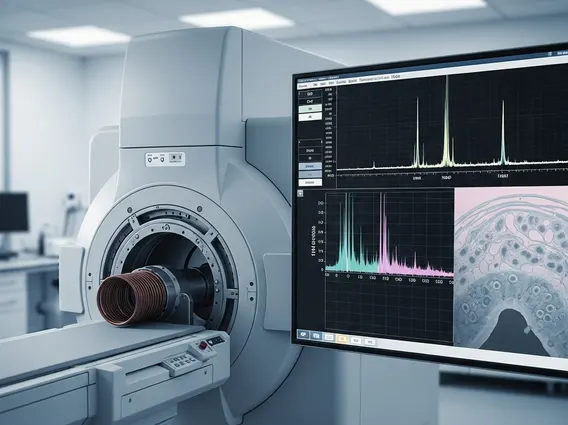
What differentiates spectroscopic imaging from standard MRI is the analysis of this emitted signal. Instead of just creating an image based on signal intensity, 1h NMRSI analyzes the subtle frequency shifts (chemical shifts) of the proton signals. These shifts are unique to the chemical environment of each proton, allowing for the identification and quantification of different metabolites. The process involves:
- Magnetic Field Application: Aligning hydrogen protons in the body.
- Radiofrequency Pulses: Exciting the protons to a higher energy state.
- Signal Detection: Measuring the emitted signals as protons relax.
- Spectral Analysis: Decomposing the complex signal into a spectrum, where peaks correspond to specific metabolites.
This spectral information is then spatially mapped, creating images that show not just anatomy, but also the distribution and concentration of these key biochemical markers across different tissues. This provides a metabolic “fingerprint” that can reveal subtle changes before they become structurally apparent.
Clinical Applications of 1h NMR Spectroscopic Imaging
The Applications of 1h NMR imaging are diverse and particularly impactful in the field of oncology and neurology. In cancer diagnosis and management, 1h NMRSI is used to characterize tumors, distinguish between benign and malignant lesions, and assess tumor aggressiveness. For instance, elevated choline levels and reduced NAA are often observed in aggressive brain tumors, while lactate peaks can indicate necrosis or hypoxia.
Beyond initial diagnosis, 1h NMRSI plays a crucial role in treatment planning and monitoring. It can help guide biopsies, delineate tumor margins more accurately for surgical resection or radiation therapy, and evaluate a tumor’s response to chemotherapy or radiation. A decrease in tumor-specific metabolites after treatment, for example, can indicate a positive response, while stable or increasing levels might suggest resistance or recurrence.
Furthermore, 1h NMRSI is being explored for its utility in other conditions, including neurological disorders like Alzheimer’s disease, multiple sclerosis, and stroke, where metabolic changes precede significant structural damage. It also holds promise in assessing metabolic diseases and understanding tissue viability in various organs, offering a non-invasive window into the biochemical processes underlying health and disease.



















