Breastbone
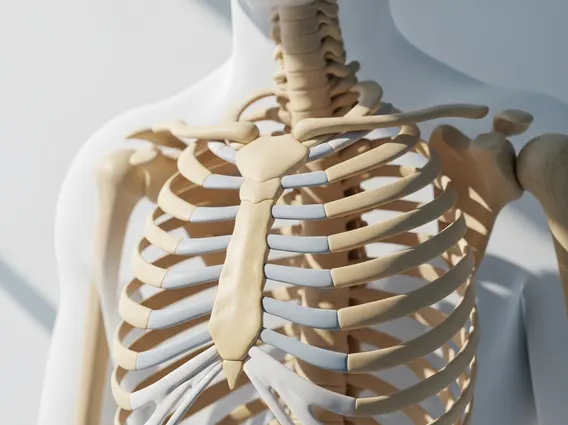
The breastbone, medically known as the sternum, is a flat, dagger-shaped bone located in the center of the chest. It plays a crucial role in protecting vital organs and providing structural support to the thoracic cage.
Key Takeaways
- The breastbone (sternum) is a flat bone in the center of the chest, integral to the rib cage.
- It consists of three main parts: the manubrium, body, and xiphoid process.
- Its primary location is anterior to the heart and lungs, articulating with the ribs and clavicles.
- The sternum’s main functions include protecting crucial organs like the heart and lungs.
- It also provides essential support and attachment points for the ribs and various chest and neck muscles.
What is the Breastbone?
The breastbone, or sternum, is a key component of the human skeletal system, forming the central part of the anterior chest wall. It is a flat, elongated bone that serves as a protective shield for the delicate organs nestled within the thoracic cavity. Understanding what is the breastbone involves recognizing its unique structure and its central position in the rib cage, where it connects to the ribs via cartilage, forming the front of the rib cage and contributing significantly to its overall rigidity and flexibility.
Anatomy and Location of the Sternum
The breastbone anatomy and location are fundamental to its protective and supportive roles within the body. This bone is strategically positioned to offer maximum defense to the vital organs behind it, while also facilitating respiratory mechanics and upper body movement.
Main Parts of the Sternum
The sternum is composed of three distinct parts that fuse together as an individual matures. These components are crucial sternum bone facts that define its structure and function:
- Manubrium: This is the broad, superior part of the sternum, resembling a knot in a tie. It articulates with the clavicles (collarbones) and the first pair of ribs.
- Body (Gladiolus): The longest part of the sternum, located centrally. It connects to the second through seventh pairs of ribs via costal cartilages.
- Xiphoid Process: The smallest and most inferior part, a pointed projection made of cartilage that usually ossifies (hardens into bone) in adulthood. It serves as an attachment point for some abdominal muscles.
Where is the Breastbone Located?
The breastbone anatomy and location place it centrally in the chest, extending from the base of the neck to the upper abdomen. Specifically, it lies anterior to the heart and lungs, providing a robust bony barrier. It articulates superiorly with the clavicles at the sternoclavicular joints and laterally with the ribs via their costal cartilages, forming the sternocostal joints. This central placement ensures that it is ideally positioned to protect the thoracic viscera from external trauma.
Key Functions of the Breastbone
The function of the breastbone extends beyond mere structural presence; it is integral to the body’s protective mechanisms and respiratory dynamics. Its robust nature and strategic connections make it a cornerstone of chest wall integrity.
Protection of Vital Organs
One of the primary roles of the sternum is the protection of vital organs. Situated directly in front of the heart, lungs, and major blood vessels (like the aorta and vena cava), the breastbone acts as a strong bony shield. This protection is critical, as trauma to this area without such a shield could lead to severe, life-threatening injuries to these essential organs. For instance, the sternum helps absorb and distribute impact forces, reducing the direct force transmitted to the underlying heart and lungs during a chest impact.
Support for Ribs and Muscles
The sternum serves as a central anchoring point for the ribs, which form the protective cage around the thoracic cavity. The true ribs (pairs 1-7) connect directly to the sternum via their own costal cartilages, while the false ribs (pairs 8-10) connect indirectly via the cartilage of the rib above. This arrangement provides stability to the rib cage, allowing it to expand and contract during respiration. Furthermore, the sternum provides attachment sites for several important muscles, including parts of the pectoralis major muscle, which is involved in arm movement, and the sternocleidomastoid muscle, which aids in neck movement and respiration. This muscular and rib support is vital for both movement and the mechanics of breathing.