Renal Fascia
The renal fascia is a crucial anatomical structure that encases the kidneys and adrenal glands, playing a vital role in their support and protection within the abdominal cavity. Understanding its intricate layers and connections is fundamental in medical and surgical contexts.
Key Takeaways
- The renal fascia, also known as Gerota’s fascia, is a fibrous connective tissue capsule surrounding the kidneys and adrenal glands.
- It consists of anterior and posterior layers that fuse superiorly, laterally, and medially, creating a closed compartment called the perirenal space.
- Its primary functions include anchoring the kidneys in place, providing protection from trauma, and containing infections or hemorrhages.
- The fascia helps maintain the anatomical position of the kidneys, preventing excessive movement.
- Clinically, its integrity is important in managing renal injuries, infections, and surgical approaches to the kidney.
What is Renal Fascia (Gerota’s Fascia)?
Renal fascia refers to a dense, fibrous connective tissue sheath that envelops the kidneys and the adrenal glands. It is also widely known as Gerota’s fascia, named after the Romanian surgeon Dumitru Gerota, who extensively described its anatomy. This fascial layer is distinct from the renal capsule, which is a thin, fibrous covering directly adherent to the kidney’s surface. The renal fascia creates a compartment, known as the perirenal space, which contains the kidney, adrenal gland, and perirenal fat. Its robust structure provides significant support and protection to these vital organs.
Anatomy and Structure of the Renal Fascia
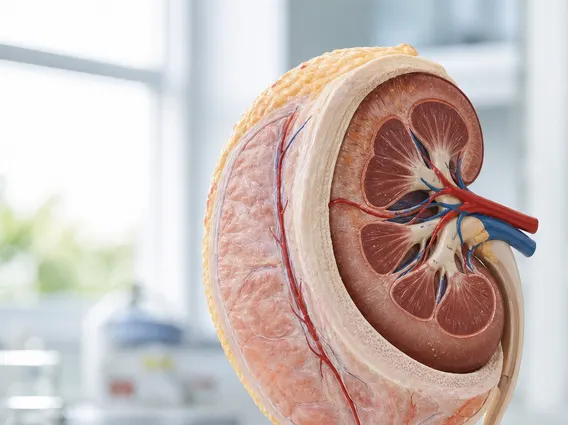
The renal fascia anatomy is complex, comprising two primary layers: an anterior layer (also known as Gerota’s fascia proper) and a posterior layer (also known as Zuckerkandl’s fascia). These layers originate from the transversalis fascia, a deep abdominal wall fascia, and extend to enclose the perirenal fat and the kidney itself. The arrangement of these layers is critical for understanding the kidney’s position and the potential spread of disease.
Key structural features include:
- Anterior Layer: This layer passes in front of the kidney and adrenal gland, extending medially to fuse with the fascia surrounding the great vessels (aorta and inferior vena cava) and the contralateral renal fascia.
- Posterior Layer: This layer passes behind the kidney and adrenal gland, fusing medially with the fascia covering the psoas and quadratus lumborum muscles.
- Superior Fusion: Both anterior and posterior layers typically fuse superiorly, enclosing the adrenal gland and attaching to the diaphragm.
- Lateral Fusion: Laterally, the two layers fuse to form a single layer that blends with the transversalis fascia.
- Inferior Opening: Inferiorly, the fusion is less complete, and the two layers remain largely separate, allowing communication with the retroperitoneal space below.
Within the perirenal space, the kidney is cushioned by perirenal fat, which further aids in protection and stabilization. Outside the renal fascia lies the pararenal fat, which provides additional padding and support.
Functions of the Renal Fascia
The function of renal fascia is multifaceted, contributing significantly to the anatomical and physiological integrity of the kidneys and adrenal glands. Its primary roles are mechanical support, protection, and containment.
Firstly, the renal fascia acts as an anchor, helping to fix the kidneys in their retroperitoneal position. This prevents excessive movement, or nephroptosis, which can sometimes lead to complications. Secondly, it provides a crucial protective barrier against external trauma. The tough, fibrous nature of the fascia, combined with the surrounding fat, helps to absorb shocks and impacts, safeguarding the delicate renal tissue. Thirdly, the renal fascia plays a vital role in containing infections or hemorrhages. If an infection or bleeding occurs within the kidney or adrenal gland, the fascial layers can help localize the spread, preventing it from disseminating rapidly into the broader retroperitoneal space. This containment is particularly important in cases of renal injury or abscess formation, guiding clinical management and surgical approaches.