Neuropathologist
A Neuropathologist is a highly specialized medical doctor who focuses on the diagnosis of diseases of the nervous system. Their expertise is crucial in understanding conditions affecting the brain, spinal cord, nerves, and muscles.
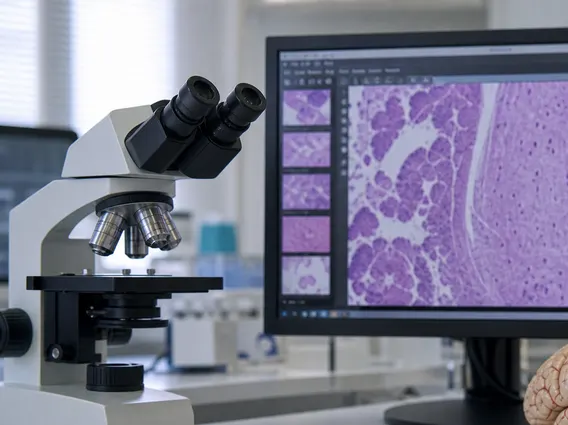
Key Takeaways
- Neuropathologists are medical specialists who diagnose nervous system diseases by examining tissue samples.
- Their work is vital for confirming diagnoses of conditions like Alzheimer’s, Parkinson’s, and brain tumors.
- They collaborate closely with neurologists, neurosurgeons, and oncologists to guide patient care.
- The career path involves extensive medical education, residency in pathology, and specialized fellowship training.
What Is a Neuropathologist?
A neuropathologist is a physician who specializes in the diagnosis of diseases of the nervous system through the examination of tissue samples. This field, often referred to as Neuropathology explained simply, involves studying the structural and molecular changes that occur in the brain, spinal cord, peripheral nerves, and muscles due to various diseases. They work primarily in laboratory settings, analyzing biopsies, surgical resections, and post-mortem tissues to identify specific pathologies.
Their work is fundamental in understanding a wide range of neurological disorders, from neurodegenerative diseases like Alzheimer’s and Parkinson’s to infectious diseases, autoimmune conditions, and tumors affecting the nervous system. By meticulously examining tissues under a microscope and employing advanced diagnostic techniques, neuropathologists provide definitive diagnoses that are critical for patient management and treatment planning.
Role of a Neuropathologist in Diagnosis
The role of a neuropathologist in diagnosis is pivotal, serving as a cornerstone for confirming neurological and neuromuscular conditions. They receive tissue samples from biopsies, surgical resections, or autopsies, which they then process and analyze. Their diagnostic process involves macroscopic examination (gross examination) followed by microscopic evaluation of stained tissue sections. This detailed analysis allows them to identify characteristic cellular and architectural changes indicative of specific diseases.
Neuropathologists often utilize a variety of specialized techniques to aid in diagnosis, including immunohistochemistry, molecular diagnostics, and electron microscopy. These methods help to pinpoint specific proteins, genetic mutations, or ultrastructural abnormalities that are hallmarks of particular diseases. Their findings are then communicated to treating physicians, such as neurologists, neurosurgeons, and oncologists, to guide therapeutic decisions and prognosis. For instance, in cases of suspected brain tumors, the neuropathologist’s precise classification of the tumor type is essential for determining the most effective course of treatment.
Key diagnostic contributions include:
- Confirming neurodegenerative diseases (e.g., Alzheimer’s disease, Parkinson’s disease).
- Classifying central nervous system tumors (e.g., gliomas, meningiomas).
- Identifying inflammatory and demyelinating conditions (e.g., multiple sclerosis).
- Diagnosing infectious diseases affecting the brain and spinal cord.
- Evaluating muscle and nerve biopsies for neuromuscular disorders.
Neuropathologist Career Path and Training
The neuropathologist career path is rigorous and requires extensive medical education and specialized training. Individuals pursuing this specialty typically complete four years of undergraduate study, followed by four years of medical school to earn a Doctor of Medicine (MD) or Doctor of Osteopathic Medicine (DO) degree. After medical school, aspiring neuropathologists undertake a residency program.
The standard training pathway involves a residency in Anatomic Pathology, which typically lasts four years. During this time, residents gain comprehensive experience in general surgical pathology, autopsy pathology, and cytopathology. Following the Anatomic Pathology residency, a specialized fellowship in Neuropathology is required, which usually spans two years. This fellowship provides intensive, focused training in the diagnosis of diseases of the nervous system, including exposure to a wide array of cases, advanced diagnostic techniques, and often research opportunities. Upon completion of fellowship training, neuropathologists must pass board certification examinations administered by the American Board of Pathology to practice independently.