Ciliary Body
The Ciliary Body is a vital structure within the eye, playing a crucial role in vision and ocular health. Understanding its anatomy and functions is essential for comprehending the intricate mechanisms that allow us to see.
Key Takeaways
- The Ciliary Body is a ring-shaped structure located behind the iris in the eye.
- It is primarily responsible for producing aqueous humor, which nourishes the eye and maintains intraocular pressure.
- The Ciliary Body also controls the shape of the lens, enabling the eye to focus on objects at varying distances (accommodation).
- Its components include the ciliary muscle and ciliary processes.
- Dysfunction of the Ciliary Body can lead to various eye conditions, including glaucoma.
What is the Ciliary Body?
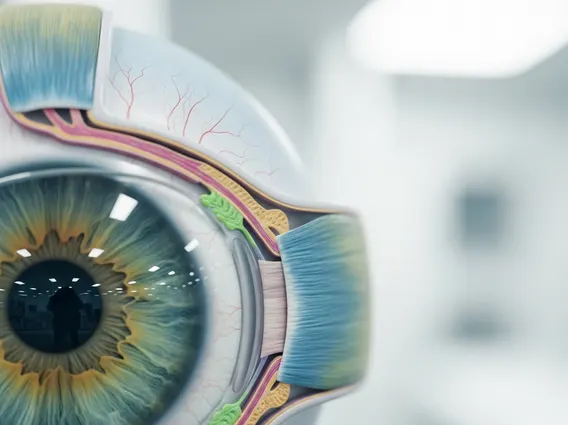
The Ciliary Body is a critical intraocular structure, forming a ring of tissue located just behind the iris and extending to the ora serrata, the anterior edge of the retina. This specialized tissue is integral to the eye’s ability to maintain its internal environment and focus light onto the retina. It is part of the uvea, the middle layer of the eye, which also includes the iris and choroid. Its unique composition and strategic placement allow it to perform two primary functions essential for vision.
Anatomy and Location of the Ciliary Body
The anatomy of the ciliary body is complex, comprising two main parts: the ciliary muscle and the ciliary processes. The ciliary muscle is a ring of smooth muscle fibers that plays a pivotal role in accommodation. These muscle fibers are arranged in longitudinal, radial, and circular orientations, allowing for a coordinated contraction that alters the tension on the suspensory ligaments of the lens. The ciliary body function and location are intrinsically linked, as its position allows it to directly influence the lens and aqueous humor production.
The ciliary processes are approximately 70-80 radial folds that extend from the ciliary body’s inner surface. These processes are covered by a double layer of epithelial cells, which are responsible for secreting aqueous humor. The aqueous humor is a clear fluid that fills the anterior and posterior chambers of the eye, providing nutrients to avascular structures like the cornea and lens, and maintaining intraocular pressure. The Ciliary Body is situated in the anterior segment of the eye, specifically in the space between the iris and the choroid.
Functions of the Ciliary Body
The ciliary body role in eye health and vision is multifaceted, primarily encompassing two vital functions:
-
Aqueous Humor Production
The ciliary processes are responsible for continuously producing aqueous humor. This fluid flows from the posterior chamber, through the pupil, into the anterior chamber, and eventually drains out of the eye via the trabecular meshwork and Schlemm’s canal. This constant production and drainage are crucial for:
- Maintaining the eye’s shape and internal pressure (intraocular pressure).
- Providing nutrients and oxygen to the avascular cornea and lens.
- Removing metabolic waste products from these structures.
Disruptions in aqueous humor dynamics can lead to conditions like glaucoma, a leading cause of irreversible blindness worldwide, affecting an estimated 80 million people globally by 2020, according to the World Health Organization (WHO).
-
Accommodation
The ciliary muscle’s contraction and relaxation enable the eye to change the shape of its lens, a process known as accommodation. When the ciliary muscle contracts, it reduces the tension on the suspensory ligaments, allowing the elastic lens to become more convex (rounder). This increases the lens’s refractive power, enabling the eye to focus on near objects. Conversely, when the ciliary muscle relaxes, tension on the suspensory ligaments increases, flattening the lens and allowing the eye to focus on distant objects. This dynamic adjustment is essential for clear vision at various distances.
The Ciliary Body’s integrated functions of fluid production and lens control underscore its indispensable contribution to the overall health and visual acuity of the eye.