
3 Tesla Mri
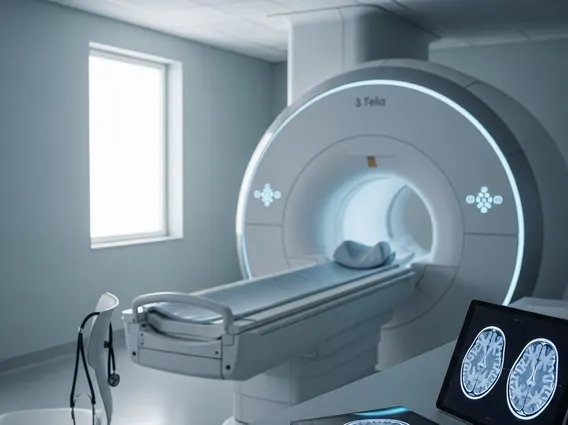
3 Tesla MRI is an advanced medical imaging technique that utilizes a powerful magnetic field to produce highly detailed images of organs, soft tissues, bone, and virtually all other internal body structures. This technology offers significant advantages in diagnostic clarity for various medical conditions.
Key Takeaways
- 3 Tesla MRI uses a magnetic field twice as strong as standard 1.5T MRI, leading to superior image resolution.
- The stronger field enhances signal-to-noise ratio, allowing for clearer visualization of fine anatomical details and subtle pathologies.
- It is particularly beneficial for neurological, musculoskeletal, and vascular imaging, providing more precise diagnostic information.
- Compared to 1.5 Tesla MRI, 3T MRI offers faster scan times for comparable image quality or higher quality in the same timeframe.
- While offering advanced capabilities, 3T MRI may have specific considerations regarding implants and artifacts.
What is 3 Tesla MRI (3T MRI)?
3 Tesla MRI (3T MRI) refers to a type of magnetic resonance imaging scanner that operates with a magnetic field strength of 3 Tesla. To understand what is 3 Tesla MRI, it’s essential to know that “Tesla” (T) is a unit of magnetic field strength. A 3T MRI scanner generates a magnetic field that is twice as strong as the more common 1.5 Tesla MRI systems and approximately 60,000 times stronger than the Earth’s magnetic field. This increased field strength is crucial for producing images with higher resolution and clarity, enabling physicians to detect smaller lesions and more subtle abnormalities that might be missed with lower-field scanners.
The enhanced magnetic field of a 3 Tesla MRI system allows for a greater signal-to-noise ratio (SNR), which directly translates into superior image quality. This advanced imaging capability is particularly valuable in specialties requiring detailed anatomical visualization, such as neuroradiology, musculoskeletal imaging, and vascular studies. The higher resolution images contribute significantly to more accurate diagnoses and better treatment planning for a wide range of medical conditions.
How 3 Tesla MRI Works and Its Benefits
How 3 Tesla MRI works is based on the same fundamental principles as other MRI systems, but with amplified effects due to its stronger magnetic field. The patient is placed inside a large, powerful magnet, which causes the protons in the body’s hydrogen atoms (primarily in water molecules) to align with the magnetic field. Radiofrequency currents are then briefly pulsed through the patient, knocking these aligned protons out of alignment. When the radiofrequency pulse is turned off, the protons relax back into alignment with the main magnetic field, releasing energy in the form of radio signals. The 3T MRI scanner detects these signals, and a computer processes them to create detailed cross-sectional images of the body.
The primary benefits of 3T MRI scan stem from its increased magnetic field strength. These advantages include:
- Higher Resolution: The stronger magnetic field allows for the acquisition of more detailed images, making it easier to visualize small structures and subtle pathological changes.
- Improved Signal-to-Noise Ratio: This leads to clearer images with less “graininess,” enhancing diagnostic confidence.
- Faster Scan Times: In many cases, 3T MRI can acquire images faster than lower-field scanners while maintaining or improving image quality, which can reduce patient discomfort and motion artifacts.
- Enhanced Contrast: The stronger field can provide better tissue contrast, particularly useful for distinguishing between healthy and diseased tissues.
- Advanced Applications: It facilitates advanced imaging techniques such as functional MRI (fMRI) for brain activity mapping, diffusion tensor imaging (DTI) for white matter tracts, and spectroscopy for biochemical analysis.
These benefits make 3 Tesla MRI an invaluable tool for diagnosing conditions ranging from neurological disorders like epilepsy and multiple sclerosis to musculoskeletal injuries and certain types of cancer.
3 Tesla MRI vs. 1.5 Tesla MRI: A Comparison
The choice between a 3 Tesla MRI and a 1.5 Tesla MRI often depends on the specific diagnostic needs, patient considerations, and the area of the body being examined. While both are powerful diagnostic tools, understanding the distinctions in 3 Tesla MRI vs. 1.5 Tesla MRI is crucial for optimal patient care. The 1.5T MRI has long been the clinical standard, offering excellent image quality for a wide range of applications. However, 3T MRI offers distinct advantages in specific scenarios due to its higher field strength.
The stronger magnetic field of the 3T system translates to a higher signal, which can be used to either achieve higher spatial resolution (finer detail) or reduce scan time while maintaining comparable image quality. This makes 3T MRI particularly advantageous for imaging smaller structures or when subtle pathology is suspected. However, the stronger field can also lead to increased susceptibility artifacts, especially near metallic implants, and may cause more heating in certain tissues. The following table summarizes key differences:
| Feature | 1.5 Tesla MRI | 3 Tesla MRI |
|---|---|---|
| Magnetic Field Strength | 1.5 Tesla | 3.0 Tesla (Twice as strong) |
| Image Resolution | Good | Excellent (Higher detail) |
| Signal-to-Noise Ratio (SNR) | Good | Superior (Clearer images) |
| Scan Time | Standard | Potentially faster for comparable quality or higher quality in same time |
| Susceptibility Artifacts | Lower risk, especially near metal | Higher risk, more sensitive to metal |
| Applications | General diagnostic imaging | Advanced neurological, musculoskeletal, vascular, and small lesion detection |
| Acoustic Noise | Moderate | Generally louder |
Ultimately, both 1.5T and 3T MRI scanners are highly effective, and the choice is often guided by the specific clinical question, patient comfort, and the expertise of the radiologist. For many routine examinations, a 1.5T MRI provides sufficient diagnostic information, while a 3T MRI is preferred for complex cases requiring the highest level of detail.



















