Epithelium
Epithelium refers to a fundamental type of animal tissue that forms the outer covering of all body surfaces and lines internal organs and cavities. It plays a crucial role in protecting the body, regulating substance movement, and facilitating various physiological processes.
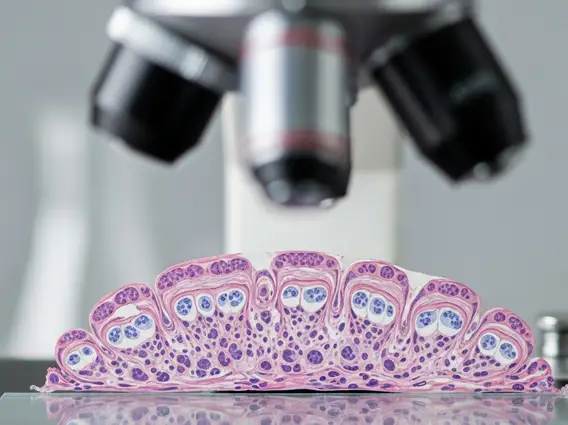
Key Takeaways
- Epithelium forms protective barriers and linings throughout the body.
- Its primary functions include protection, secretion, absorption, filtration, and sensory reception.
- Epithelial tissue is classified by cell shape (squamous, cuboidal, columnar) and the number of cell layers (simple, stratified, pseudostratified, transitional).
- Characterized by tightly packed cells, polarity, and a high capacity for regeneration.
- Found lining organs, cavities, blood vessels, and forming glands.
What is Epithelium and Its Primary Functions?
Epithelium is one of the four basic types of animal tissue, alongside connective, muscle, and nervous tissues. It consists of closely packed cells that form continuous sheets, creating barriers and linings throughout the body. This tissue type is distinguished by its cellularity, specialized contacts, polarity, support by connective tissue, avascularity, and high regenerative capacity.
The primary roles of epithelial tissue and its function are diverse and vital for maintaining bodily homeostasis. These functions include:
- Protection: Shielding underlying tissues from mechanical injury, pathogens, and dehydration, as seen in the skin.
- Absorption: Taking in substances from the lumen of organs, such as nutrients in the small intestine.
- Secretion: Producing and releasing substances like hormones, mucus, and enzymes, a function of glandular epithelium.
- Filtration: Regulating the passage of substances, exemplified by the kidney tubules.
- Sensory Reception: Containing specialized cells that detect stimuli, such as taste buds in the tongue.
These functions are critical for the proper operation of organ systems, from digestion and respiration to excretion and sensation.
Types, Structure, and Locations of Epithelial Tissue
The Structure and characteristics of epithelium are highly adapted to its specific functions and locations. Epithelial cells are tightly bound together by various cell junctions (e.g., tight junctions, desmosomes, gap junctions), which minimize the extracellular matrix between them. This close packing allows epithelium to form effective barriers. Epithelial cells also exhibit polarity, meaning they have distinct apical (free) and basal (attached) surfaces, each with specialized structures and functions. The basal surface is typically attached to an underlying basement membrane, a thin, non-cellular layer that provides structural support and acts as a selective filter. Unlike most other tissues, epithelium is avascular, meaning it lacks its own blood supply; it receives nutrients via diffusion from the underlying connective tissue. However, it is innervated, containing nerve endings that allow for sensory perception. Epithelial tissue also has a remarkable capacity for regeneration, allowing it to repair itself quickly after injury.
There are Different types of epithelium in human body, primarily classified based on the shape of the cells and the number of cell layers. This classification helps in understanding their specialized roles and distributions:
| Type of Epithelium | Cell Shape & Layers | Key Characteristics | Common Locations |
|---|---|---|---|
| Simple Squamous | Single layer of flat, scale-like cells | Thin, permeable; ideal for diffusion and filtration | Lining of blood vessels (endothelium), air sacs of lungs (alveoli), kidney glomeruli |
| Simple Cuboidal | Single layer of cube-shaped cells | Involved in secretion and absorption | Kidney tubules, ducts of small glands, ovary surface |
| Simple Columnar | Single layer of tall, column-shaped cells | Specialized for absorption and secretion; may have microvilli or cilia | Lining of digestive tract (stomach to rectum), gallbladder |
| Pseudostratified Columnar | Single layer of cells of varying heights, nuclei at different levels; appears stratified but isn’t | Often ciliated; secretes and propels mucus | Lining of trachea and most of the upper respiratory tract |
| Stratified Squamous | Multiple layers of cells, apical cells are flattened | Protects against abrasion; can be keratinized (skin) or non-keratinized (mouth) | Epidermis of skin, lining of esophagus, mouth, vagina |
| Transitional | Multiple layers of cells that can stretch and flatten | Allows for distension of organs | Lining of urinary bladder, ureters, part of the urethra |
The Epithelial tissue location and purpose are intrinsically linked. For instance, simple squamous epithelium is found in areas where rapid diffusion is essential, such as the alveoli of the lungs, facilitating gas exchange. Stratified squamous epithelium, with its multiple layers, provides robust protection against abrasion and is found in the skin and the lining of the mouth. Glandular epithelium forms the secretory units of glands, producing substances like sweat, hormones, and digestive enzymes. The lining of the digestive tract, composed of simple columnar epithelium, is specialized for nutrient absorption. This diverse distribution and specialization underscore epithelium’s critical role in the overall structure and function of the human body.