Skull
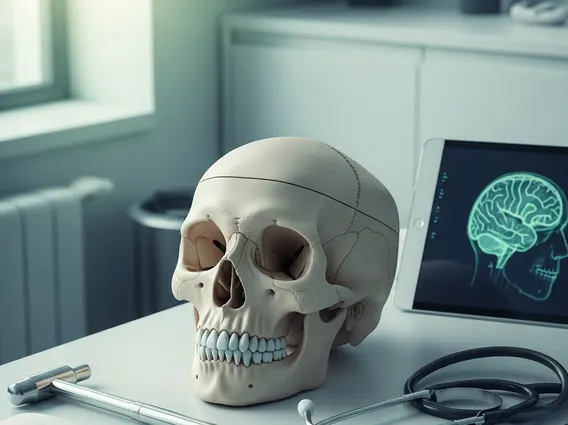
The skull is a complex and vital bony structure that forms the head in vertebrates. It serves as a crucial protective casing for the brain and provides the essential framework for the face, housing many sensory organs.
Key Takeaways
- The skull is a complex bony structure protecting the brain and forming the facial framework.
- An adult human skull typically consists of 22 bones, divided into cranial and facial bones.
- Its primary functions include safeguarding the brain, supporting facial structures, and housing sensory organs.
- The cranial bones form the neurocranium, enclosing the brain, while facial bones form the viscerocranium.
- Understanding the skull’s anatomy is crucial for comprehending its protective and functional roles in the human body.
What is the Skull?
The Skull refers to the bony framework of the head, providing both robust protection for the brain and a structural foundation for the face. This intricate structure is a defining feature of vertebrates, playing a crucial role in supporting sensory organs and facilitating the mastication process. The purpose of the skull in humans extends beyond mere protection; it also anchors muscles for head movement and facial expressions, and houses the initial parts of the respiratory and digestive systems. It is a robust yet adaptable structure, designed to withstand external forces while accommodating the delicate tissues within.
How Many Bones Make Up the Human Skull?
An adult human skull is typically composed of 22 individual bones, excluding the three tiny ossicles (malleus, incus, and stapes) in each middle ear. These 22 bones are intricately joined together, mostly by immovable joints called sutures, which allow for minimal flexibility but provide immense strength. The bones of the skull are broadly categorized into two main groups: the neurocranium (cranial bones) and the viscerocranium (facial bones).
- Cranial Bones (8): These bones form the protective casing around the brain. They include the frontal, two parietal, two temporal, occipital, sphenoid, and ethmoid bones.
- Facial Bones (14): These bones form the structure of the face, supporting the eyes, nose, and mouth. They include two nasal, two lacrimal, two inferior nasal conchae, two maxillae, two palatine, two zygomatic, the vomer, and the mandible.
This precise arrangement ensures both the safety of the brain and the complex functionality of the face.
Human Skull Anatomy and Functions
The human skull anatomy and function are remarkably specialized, reflecting its dual role in protection and support. The skull’s overall structure is designed to absorb impact and distribute forces, thereby safeguarding the brain from injury. Its intricate design also supports a wide array of sensory and motor functions essential for daily life.
The parts of the human skull explained can be understood by examining its two primary divisions:
- Neurocranium: This part forms the cranial vault, or braincase, which encloses and protects the brain. It consists of eight bones that fuse together, particularly after infancy. The internal surface of the neurocranium is contoured to cradle the brain, while its external surface provides attachment points for neck and scalp muscles.
- Viscerocranium: Comprising the facial skeleton, this section provides the framework for the face. It supports the sensory organs of sight, smell, and taste, and forms the entrances to the digestive and respiratory tracts. Key functions of the viscerocranium include:
- Protection of Sensory Organs: The orbits protect the eyes, while the nasal cavity houses the olfactory receptors.
- Support for Mastication: The maxillae (upper jaw) and mandible (lower jaw) are crucial for chewing, housing the teeth and providing attachment for powerful jaw muscles.
- Facial Expression: Numerous small muscles attach to the facial bones, allowing for a wide range of expressions vital for human communication.
Together, these components of the skull ensure the survival and proper functioning of critical physiological processes. The robust nature of the skull, combined with its intricate design, makes it one of the most vital structures in the human body.