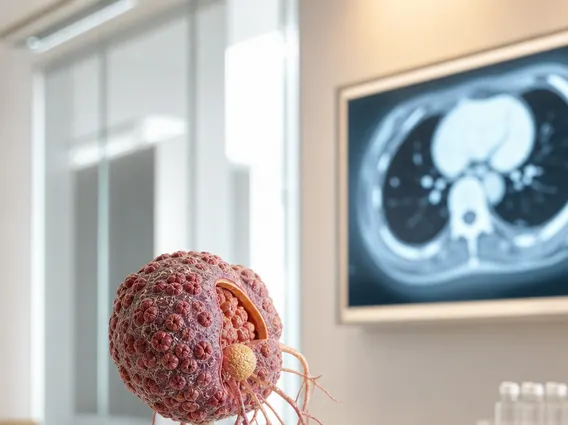
Secondary Tumor
A secondary tumor represents a significant challenge in oncology, indicating that cancer has spread from its original site to another part of the body. Understanding its nature, formation, and distinction from the primary cancer is crucial for effective diagnosis and treatment.

Key Takeaways
- A secondary tumor is formed when cancer cells from a primary tumor spread to a new location in the body.
- This process, known as metastasis, involves cancer cells detaching, traveling through the bloodstream or lymphatic system, and establishing new growths.
- Secondary tumors are composed of the same type of cancer cells as the primary tumor, not new cancer cells.
- Distinguishing between primary and secondary tumors is vital for accurate staging and guiding appropriate treatment strategies.
- While a primary tumor is the initial site of cancer, secondary tumors indicate advanced disease and often require systemic therapies.
What is Secondary Tumor?
A secondary tumor, also known as a metastatic tumor, refers to a new cancerous growth that originates from cancer cells that have spread from a primary tumor located elsewhere in the body. The secondary tumor definition clarifies that these growths are not new, independent cancers but rather extensions of the original disease. For instance, if breast cancer spreads to the lungs, the lung tumor is a secondary breast cancer, not a primary lung cancer. This distinction is critical because the secondary tumor consists of the same type of cancer cells as the primary tumor, retaining its characteristics and requiring treatment strategies tailored to the original cancer type.
The development of secondary tumors signifies that the cancer has become advanced, often referred to as metastatic cancer. According to the World Health Organization (WHO), cancer is a leading cause of death worldwide, and metastasis is responsible for approximately 90% of cancer-related deaths, highlighting the profound impact of secondary tumor formation on patient outcomes.
Mechanisms of Secondary Tumor Formation
Understanding how do secondary tumors form involves comprehending the complex process of metastasis. This multi-step process allows cancer cells to detach from the primary tumor, invade surrounding tissues, enter the circulatory or lymphatic systems, travel to distant sites, and then establish new colonies. The journey of these malignant cells can be broken down into several key stages:
- Local Invasion: Cancer cells break away from the primary tumor and infiltrate adjacent healthy tissues.
- Intravasation: These invasive cells enter blood vessels (hematogenous spread) or lymphatic vessels (lymphatic spread).
- Circulation: Cancer cells travel through the bloodstream or lymphatic system, often encountering immune cells and other challenges.
- Extravasation: Surviving cancer cells exit the vessels at a distant site and invade new tissues.
- Colonization: The cells adapt to the new microenvironment, proliferate, and form a new tumor, which is the secondary tumor.
Not all cancer cells that enter the bloodstream or lymphatic system successfully form secondary tumors. Many are destroyed by the immune system or fail to adapt to the new environment. However, those that do survive and proliferate lead to the formation of these new growths, which can occur in various organs, most commonly the bones, lungs, liver, and brain, depending on the type of primary cancer.
Distinguishing Secondary vs. Primary Tumors
The distinction between a secondary tumor vs primary tumor is fundamental in oncology, impacting diagnosis, prognosis, and treatment decisions. A primary tumor is the initial site where cancer originates, representing the first group of abnormal cells that began to divide uncontrollably. In contrast, a secondary tumor is a metastatic lesion, meaning it is derived from cells that have migrated from that primary site.
Clinically, pathologists can often differentiate between primary and secondary tumors by examining the cell characteristics under a microscope. The cells of a secondary tumor will typically resemble those of the primary tumor, even if they are found in a different organ. For example, if a liver biopsy reveals cells characteristic of colon cancer, it indicates a secondary tumor originating from the colon, not a primary liver cancer. This distinction guides oncologists in selecting the most appropriate systemic therapies, which are often different for metastatic disease than for localized primary cancer.
| Feature | Primary Tumor | Secondary Tumor (Metastatic) |
|---|---|---|
| Origin | Initial site where cancer first develops. | Formed by cancer cells that spread from a primary tumor. |
| Cell Type | Determines the type of cancer (e.g., primary lung cancer cells). | Composed of the same cell type as the primary tumor (e.g., lung tumor made of breast cancer cells). |
| Location | The original organ or tissue where the cancer began. | Distant from the primary site, in a different organ or tissue. |
| Diagnosis | Identified as the first cancerous growth. | Identified as a spread of an existing cancer. |
| Treatment Implications | Often treated with localized therapies (surgery, radiation) if early. | Typically indicates advanced disease, often requiring systemic therapies (chemotherapy, targeted therapy, immunotherapy). |
Accurate identification of primary versus secondary tumors is crucial for cancer staging, which helps determine the extent of the disease and predict its course. Misidentifying a secondary tumor as a new primary cancer could lead to incorrect treatment, highlighting the importance of thorough diagnostic workup, including imaging and biopsy, to ensure precise patient management.