Breslow Depth
Breslow Depth is a critical measurement used in the assessment of melanoma, a serious form of skin cancer. It quantifies the vertical thickness of the tumor, providing essential information for prognosis and treatment planning.
Key Takeaways
- Breslow Depth measures the vertical thickness of a melanoma tumor from the skin’s surface.
- It is a primary prognostic indicator for melanoma, directly influencing treatment decisions and survival rates.
- The measurement is performed microscopically by a pathologist on a biopsy sample.
- Thinner melanomas generally have a better prognosis compared to thicker ones.
- It is a key component in the TNM (Tumor, Node, Metastasis) staging system for melanoma.
What is Breslow Depth?
What is Breslow Depth? It is a pathological measurement that determines the vertical thickness of a primary melanoma tumor. Specifically, it measures the distance in millimeters from the top of the granular layer of the epidermis (or the base of a superficial ulcer) down to the deepest identifiable melanoma cell. This measurement is fundamental to understanding the potential aggressiveness of the tumor. The Breslow Depth melanoma meaning is profound, as it serves as one of the most important prognostic factors for patients diagnosed with this type of skin cancer. A greater Breslow Depth indicates a higher risk of the cancer spreading and a less favorable prognosis.
How Breslow Depth is Measured
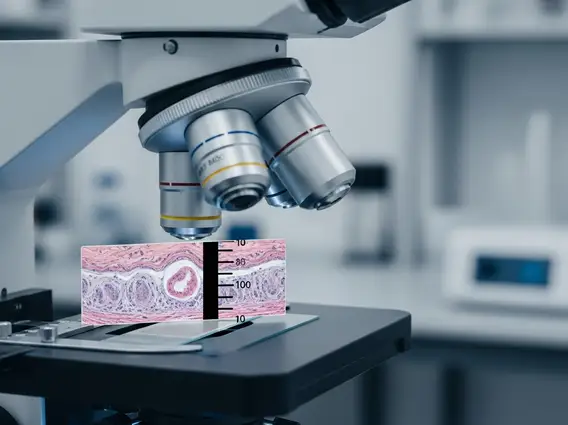
How is Breslow Depth measured? The measurement of Breslow Depth is a precise process conducted by a pathologist following the surgical removal of a suspected melanoma. After a biopsy is performed, the tissue sample is carefully processed, sectioned, and stained. The pathologist then examines these prepared slides under a microscope. Using a calibrated ocular micrometer, the pathologist measures the vertical distance from the top of the epidermis to the deepest point where melanoma cells are found. This measurement is typically reported in millimeters (mm) and is a crucial piece of information for the patient’s medical team.
Pathological Assessment Process
The pathological assessment process involves several meticulous steps to ensure accuracy:
- Biopsy: A suspicious lesion is removed, usually through an excisional biopsy, ensuring the entire lesion and a margin of surrounding healthy tissue are obtained.
- Tissue Preparation: The tissue is fixed in formalin, embedded in paraffin wax, and then cut into very thin sections.
- Staining: These sections are stained with hematoxylin and eosin (H&E) to highlight cellular structures and allow for clear visualization of the melanoma cells.
- Microscopic Examination: The pathologist meticulously examines the stained slides, identifying the deepest point of tumor invasion to determine the Breslow Depth.
Breslow Depth in Melanoma Staging
The Breslow Depth staging explained is integral to the TNM (Tumor, Node, Metastasis) staging system, which is the globally recognized standard for classifying cancer. In this system, ‘T’ refers to the primary tumor, and Breslow Depth is the primary determinant for the T-stage of melanoma. For example, a melanoma with a Breslow Depth of less than 1.0 mm is typically classified as T1, while thicker melanomas are assigned higher T-stages, indicating a more advanced disease. This staging is critical because it guides treatment decisions, including the need for wider surgical margins, sentinel lymph node biopsy, or systemic therapies.
Prognostic Significance
The prognostic significance of Breslow Depth cannot be overstated. It is one of the most powerful predictors of patient outcome and the likelihood of metastasis. Generally, thinner melanomas (e.g., <1.0 mm) are associated with an excellent prognosis and a very low risk of spread. As the Breslow Depth increases, the risk of regional lymph node involvement and distant metastasis rises significantly. For instance, according to data from the American Cancer Society, the 5-year survival rate for localized melanoma (often associated with thinner Breslow Depths) is approximately 99%, while it drops for regional or distant disease. This direct correlation makes Breslow Depth a cornerstone in counseling patients about their disease course and tailoring appropriate management strategies.