Skin Cancer Signs & Symptoms
Understanding the skin cancer symptoms is crucial for early detection and successful treatment. This guide provides essential information on identifying suspicious changes on your skin, empowering you to take proactive steps for your health.
Key Takeaways
- Regular self-skin exams are vital for detecting early symptoms of skin cancer.
- Familiarize yourself with the ABCDEs of melanoma to identify suspicious moles.
- Basal cell carcinoma often appears as a pearly or waxy bump, while squamous cell carcinoma may look like a firm, red nodule or a flat, scaly lesion.
- Any new, changing, or non-healing lesion, especially those with irregular borders or varying colors, warrants immediate medical attention.
- Consult a dermatologist promptly if you notice any concerning skin cancer warning signs.
Common Skin Cancer Symptoms
Recognizing the various skin cancer symptoms is the first step in protecting your skin health. Skin cancer can manifest in many forms, and its appearance can vary significantly depending on the type. While some signs are subtle, others are more pronounced, making regular self-examinations indispensable.
Early Indicators of Melanoma
Melanoma, the most serious type of skin cancer, often presents with distinct early symptoms of skin cancer. These can include changes in an existing mole or the appearance of a new, unusual growth. According to the American Academy of Dermatology (AAD), melanoma is highly curable when detected and treated early. Key indicators to watch for include moles that are asymmetrical, have irregular borders, uneven color, or are larger than 6mm in diameter. Any mole that evolves in size, shape, color, or elevation, or that starts to itch, bleed, or crust, should be considered a significant skin cancer warning sign.
Basal and Squamous Cell Signs
Basal cell carcinoma (BCC) and squamous cell carcinoma (SCC) are the most common types of skin cancer. BCC, accounting for about 8 out of 10 skin cancers, frequently appears as a pearly or waxy bump, often with visible blood vessels, on sun-exposed areas like the face, ears, or neck. It can also manifest as a flat, flesh-colored or brown lesion resembling a scar, or a sore that heals and then returns. Squamous cell carcinoma, the second most common type, often looks like a firm, red nodule, or a flat lesion with a scaly, crusted surface. These lesions commonly appear on sun-exposed skin, such as the face, ears, neck, lips, and hands. Both BCC and SCC can be itchy, tender, or bleed easily, and they may not heal properly, serving as important skin cancer warning signs.
Identifying Suspicious Moles
Effective identifying skin cancer on your body often begins with careful observation of your moles. While most moles are harmless, some can develop into melanoma or indicate a higher risk. Knowing what to look for can make a significant difference in early detection.
The ABCDEs of Melanoma
The ABCDE rule is a widely recognized tool for assessing moles and identifying potential melanoma. Understanding what do skin cancer moles look like often involves applying these criteria:
| Criterion | Description | What to Look For |
|---|---|---|
| Asymmetry | One half of the mole does not match the other half. | If you draw a line through the middle, the two halves are different. |
| Border Irregularity | The edges are ragged, notched, blurred, or poorly defined. | Uneven, scalloped, or poorly delineated edges. |
| Color Variation | The mole has different shades of brown, tan, black, or sometimes red, white, or blue. | Presence of multiple colors or uneven distribution of color within the mole. |
| Diameter | The mole is larger than 6 millimeters (about the size of a pencil eraser). | Any mole larger than 6mm, though melanomas can sometimes be smaller. |
| Evolving | The mole is changing in size, shape, color, or elevation, or any new symptom like bleeding, itching, or crusting. | Any noticeable change over time, or new sensations associated with the mole. |
These criteria help in recognizing potentially dangerous moles that require professional evaluation. The presence of one or more of these characteristics should prompt a visit to a dermatologist.
When a Mole Needs Checking
Beyond the ABCDEs, certain other characteristics indicate when a mole needs checking by a medical professional. Any mole that is new and appears after the age of 30, or any mole that stands out from the rest (often called the “ugly duckling” sign), should be examined. Moles that are painful, tender to the touch, or that bleed spontaneously without injury are also significant concerns. Furthermore, if you have a family history of melanoma or a large number of moles (over 50), you are at a higher risk and should have regular professional skin checks. Early detection significantly improves outcomes for all types of skin cancer, making timely consultation crucial.
How to Check Your Skin for Cancer
Regular self-examinations are a powerful tool in how to check for skin cancer and can lead to the early detection of suspicious lesions. The American Academy of Dermatology recommends performing a self-skin exam monthly. This proactive approach allows you to become familiar with your skin’s normal appearance and quickly spot any new or changing moles, spots, or lesions.
Step-by-Step Self-Exam Guide
Performing a thorough self-skin exam requires attention to detail and good lighting. Here’s a step-by-step guide:
- Start in a well-lit room: Use a full-length mirror and a hand-held mirror.
- Examine your face: Look at your face, nose, lips, mouth, and ears. Don’t forget to check behind your ears and your scalp by parting your hair.
- Check your hands: Inspect the palms and backs of your hands, between your fingers, and under your fingernails.
- Scan your arms: Look at your forearms, upper arms, and armpits.
- Examine your torso: Use the full-length mirror to check your chest and abdomen. Women should lift their breasts to check the skin underneath.
- Inspect your neck and shoulders: Turn your back to the full-length mirror and use the hand-held mirror to examine your neck, shoulders, upper back, and lower back.
- Check your legs: Sit down and examine your thighs, shins, and calves. Don’t forget the tops of your feet, between your toes, and under your toenails.
- Look at your soles: Use the hand-held mirror to check the soles of your feet and your heels.
- Examine your buttocks and genitals: Use the hand-held mirror to check these private areas.
Pay close attention to any moles, blemishes, or birthmarks, noting their size, shape, color, and texture. If you find anything new, changing, or unusual, make an appointment with a dermatologist.
Areas Prone to Skin Cancer
While skin cancer can develop anywhere on the body, certain areas prone to skin cancer are more common due to higher sun exposure. These include the face, ears, neck, scalp, chest, arms, and hands. However, it’s crucial to remember that skin cancer can also appear in areas not typically exposed to the sun, such as the soles of the feet, palms of the hands, under fingernails or toenails, and even in the genital area. Melanoma, in particular, can occur in less obvious locations, emphasizing the importance of a full-body self-exam. For instance, acral lentiginous melanoma, a rare form, often appears on the palms, soles, or under the nails. Therefore, a comprehensive check of all skin surfaces is essential for thorough detection of skin cancer symptoms.
When to Consult a Dermatologist
Knowing when to consult a dermatologist is critical for early diagnosis and effective treatment of skin cancer. While self-exams are vital for initial detection, only a medical professional can provide an accurate diagnosis. You should schedule an appointment with a dermatologist if you observe any of the following:
- A new mole or growth that appears suspicious.
- An existing mole that changes in size, shape, color, or texture (following the ABCDEs).
- A sore that doesn’t heal within a few weeks.
- Any skin lesion that bleeds, itches, or is painful.
- A dark streak under a nail that is not due to an injury.
- You have a personal or family history of skin cancer, especially melanoma.
- You have many moles or atypical moles that make self-monitoring difficult.
Regular professional skin checks, especially for individuals at higher risk, are an indispensable part of a comprehensive skin health strategy. Early intervention significantly improves the prognosis for all forms of skin cancer.
Frequently Asked Questions
Here are answers to some common questions about identifying skin cancer.
What are the most common skin cancer symptoms?
The most common skin cancer symptoms include new growths, changes in existing moles, or sores that do not heal. Basal cell carcinoma often presents as a pearly or waxy bump. Squamous cell carcinoma may appear as a firm, red nodule or a flat, scaly lesion. Melanoma, the most serious type, is characterized by moles exhibiting asymmetry, irregular borders, varied color, a diameter larger than 6mm, or any evolution in appearance. Any persistent, unusual skin change warrants medical evaluation.
Can I tell if a mole is cancerous just by looking at it?
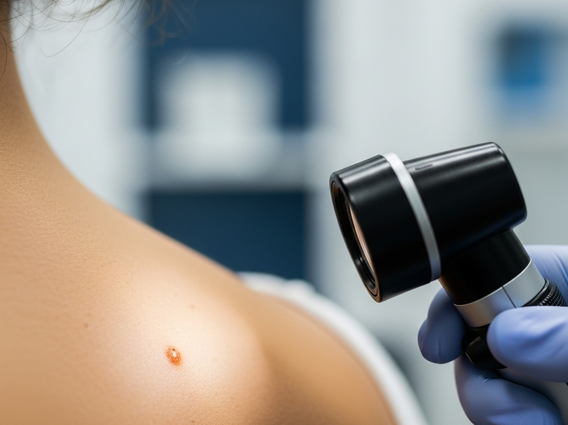
While you can identify suspicious characteristics using the ABCDE rule, you cannot definitively tell if a mole is cancerous just by looking at it. Self-examination helps in identifying potential skin cancer warning signs, but a definitive diagnosis requires a dermatologist’s expertise. They will perform a thorough examination, possibly using a dermatoscope, and may take a biopsy for laboratory analysis. Always consult a professional for any mole that concerns you, as early diagnosis is crucial.
How often should I perform a self-skin exam?
It is generally recommended to perform a self-skin exam monthly. This regular habit allows you to become familiar with your skin’s normal appearance and helps you quickly notice any new or changing moles, spots, or lesions. Consistent self-monitoring is a key component in the early detection of skin cancer symptoms, complementing annual professional skin checks, especially for individuals with a higher risk of developing skin cancer.