
Skeleton
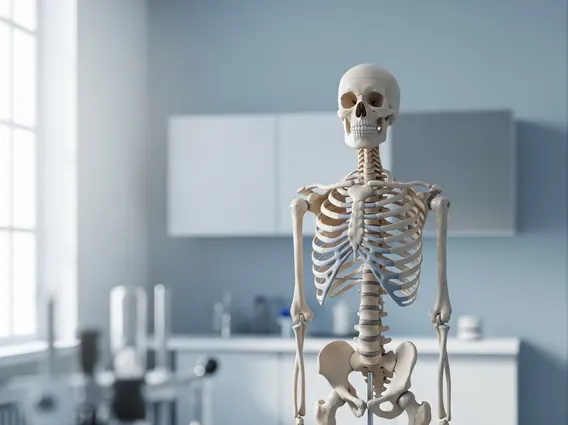
The human skeleton is an intricate internal framework that provides fundamental support, protection, and mobility for the body. Comprising a complex network of bones, cartilage, ligaments, and tendons, it is essential for overall physiological function.
Key Takeaways
- The adult human skeleton typically consists of 206 bones, forming the body’s primary structural support.
- It is divided into two main parts: the axial skeleton (skull, vertebral column, rib cage) and the appendicular skeleton (limbs, girdles).
- Key functions include providing structural support, protecting vital organs, facilitating movement, storing minerals, and producing blood cells.
- Bones are categorized into five main types: long, short, flat, irregular, and sesamoid, each with distinct shapes and roles.
- Understanding the skeletal system is crucial for comprehending human anatomy and physiology.
What is the Human Skeleton? Anatomy and Bone Count
The human skeletal system anatomy refers to the entire framework of bones and connective tissues that provides structure to the human body. This vital system is more than just a collection of bones; it is a dynamic, living tissue that constantly remodels itself. The skeleton serves as the foundation upon which the rest of the body is built, enabling upright posture and facilitating interaction with the environment.
Regarding how many bones in human skeleton, a typical adult human skeleton is composed of 206 bones. This number is generally accepted in medical consensus, though infants are born with approximately 300 bones, many of which fuse together during growth and development. The skeletal system is broadly categorized into two main divisions:
- Axial Skeleton: This central part of the skeleton consists of 80 bones and includes the skull, vertebral column (spine), and the thoracic cage (ribs and sternum). Its primary role is to protect the brain, spinal cord, and organs in the thorax.
- Appendicular Skeleton: Comprising 126 bones, this division includes the bones of the upper and lower limbs, as well as the pectoral (shoulder) and pelvic (hip) girdles that attach the limbs to the axial skeleton. It is primarily responsible for locomotion and manipulation of objects.
Each bone within these divisions contributes to the overall integrity and function of the skeletal system, working in concert with muscles, ligaments, and tendons to allow for a vast range of movements and activities.
Functions and Types of Bones in the Human Body
The human skeleton functions are diverse and critical for survival. Beyond merely providing a rigid framework, the skeletal system plays several indispensable roles in the body. These functions include:
- Support: The skeleton provides a rigid framework that supports the body’s weight and maintains its shape.
- Protection: Bones enclose and protect delicate internal organs, such as the brain (skull), heart and lungs (rib cage), and spinal cord (vertebrae).
- Movement: Bones act as levers, and joints serve as fulcrums, allowing muscles to pull on them to produce movement.
- Mineral Storage: Bones are a reservoir for essential minerals, particularly calcium and phosphorus, which can be released into the bloodstream to maintain homeostatic levels.
- Blood Cell Production (Hematopoiesis): Red bone marrow, found within certain bones, is responsible for producing red blood cells, white blood cells, and platelets.
The types of bones in human body are classified based on their shape and function. This classification helps in understanding their specific roles within the skeletal system:
| Bone Type | Description | Example |
|---|---|---|
| Long Bones | Longer than they are wide, with a shaft and two ends; primarily involved in movement and support. | Femur (thigh bone), Humerus (upper arm bone) |
| Short Bones | Roughly cube-shaped, providing stability and some movement. | Carpals (wrist bones), Tarsals (ankle bones) |
| Flat Bones | Thin, flattened, and often curved; provide protection for internal organs and broad surfaces for muscle attachment. | Scapula (shoulder blade), Cranial bones (skull) |
| Irregular Bones | Have complex shapes that do not fit into other categories; provide specific functions like protection and muscle attachment. | Vertebrae (spinal bones), Pelvic bones |
| Sesamoid Bones | Small, round bones embedded within tendons, typically found where a tendon passes over a joint; protect tendons from stress and improve mechanical advantage. | Patella (kneecap) |
Each type of bone is uniquely adapted to perform its specific functions, contributing to the overall strength, flexibility, and physiological processes of the human body.



















