
Osseous Tissue
Osseous tissue, commonly known as bone tissue, is a specialized connective tissue that forms the skeletal framework of the human body. It is a dynamic and living tissue that constantly undergoes remodeling throughout life.
Key Takeaways
- Osseous tissue is the primary component of bone, providing structural support and protection.
- It is a specialized connective tissue composed of cells (osteoblasts, osteocytes, osteoclasts) and an extracellular matrix.
- Key functions include support, protection, mineral storage, blood cell production, and leverage for movement.
- There are two main types: compact (cortical) bone and spongy (cancellous) bone, each with distinct structural characteristics.
- Bone tissue is dynamic, undergoing continuous remodeling to maintain strength and adapt to mechanical stress.
What is Osseous Tissue?
Osseous tissue refers to the hard, dense connective tissue that constitutes the majority of the skeleton in vertebrates. It is a complex and living tissue, not merely an inert support structure. The bone tissue definition characteristics include its remarkable strength, rigidity, and capacity for self-repair. This tissue is crucial for maintaining the body’s structural integrity and performing various physiological roles. It is composed of cells embedded within a mineralized extracellular matrix, which gives bone its characteristic hardness.
Structure and Functions of Osseous Tissue
The osseous tissue function and structure are intrinsically linked, allowing it to perform its diverse roles. Structurally, osseous tissue is composed of several cell types and a robust extracellular matrix. The primary cells found within bone tissue include:
- Osteoblasts: Responsible for synthesizing and secreting the organic components of the matrix, primarily collagen, and initiating mineralization.
- Osteocytes: Mature bone cells derived from osteoblasts, trapped within the mineralized matrix. They maintain the bone tissue and sense mechanical stress.
- Osteoclasts: Large, multinucleated cells responsible for bone resorption, breaking down the matrix to release minerals and remodel bone.
The extracellular matrix consists of organic components (mainly collagen fibers, providing flexibility and tensile strength) and inorganic components (primarily hydroxyapatite crystals, a calcium phosphate mineral, providing hardness and compressive strength).
The functions of osseous tissue are vital for overall body health and include:
- Support: Provides a rigid framework that supports the body and maintains its shape.
- Protection: Shields delicate internal organs, such as the brain (skull), heart, and lungs (rib cage).
- Movement: Serves as attachment points for muscles, acting as levers to facilitate body movement.
- Mineral Storage: Acts as a reservoir for essential minerals, particularly calcium and phosphate, releasing them into the bloodstream as needed to maintain mineral homeostasis.
- Hematopoiesis: The red bone marrow within certain bones is the primary site for the production of blood cells (red blood cells, white blood cells, and platelets).
Types of Osseous Tissue
There are two main types of osseous tissue, each adapted for specific mechanical demands and locations within the skeletal system: compact bone and spongy bone.
Compact bone, also known as cortical bone, is the denser and stronger of the two types. It forms the outer layer of all bones and the shafts of long bones. Its structural unit is the osteon (or Haversian system), which consists of concentric rings of lamellae (mineralized matrix) surrounding a central Haversian canal containing blood vessels and nerves. This dense arrangement provides significant resistance to bending and compression, making it ideal for bearing weight and providing protection.
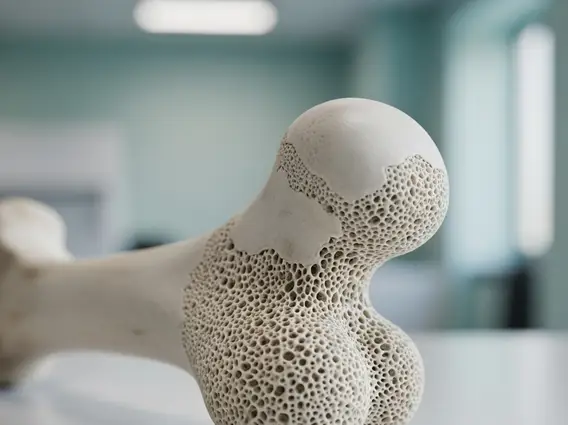
Spongy bone, also called cancellous or trabecular bone, is less dense and more porous than compact bone. It is found in the interior of bones, particularly at the ends of long bones and within flat bones. Spongy bone consists of a network of interconnected bony struts called trabeculae. These trabeculae are arranged along lines of stress, providing strength with minimal weight. The spaces between the trabeculae are filled with red bone marrow, where hematopoiesis occurs. While less dense, spongy bone is still remarkably strong and plays a crucial role in absorbing shock and distributing stress.



















