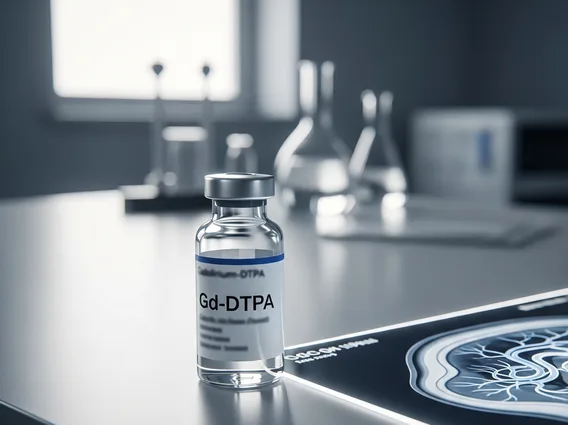
Gd Dtpa
Gd DTPA is a crucial contrast agent used in magnetic resonance imaging (MRI) to enhance the visibility of tissues and lesions. Its unique properties allow for improved diagnostic accuracy in various medical conditions.
Key Takeaways
- Gd DTPA is a gadolinium-based contrast agent primarily used in MRI scans.
- It functions by altering the magnetic properties of water molecules, which enhances image contrast.
- Its main applications include detecting tumors, inflammation, and vascular abnormalities.
- Potential adverse reactions range from mild discomfort to rare, severe conditions like Nephrogenic Systemic Fibrosis (NSF).
- Strict patient screening, especially for kidney function, and adherence to dosage guidelines are vital for safe administration.
What is Gd DTPA (Gadopentetate Dimeglumine)?
Gd DTPA (Gadopentetate Dimeglumine) is a paramagnetic contrast agent widely employed in magnetic resonance imaging (MRI). It consists of a gadolinium ion chelated to diethylenetriaminepentaacetic acid (DTPA), which is essential for reducing the toxicity of free gadolinium. This agent is administered intravenously to patients undergoing MRI scans, where it significantly improves the differentiation between normal and abnormal tissues. Its primary function is to shorten the T1 relaxation time of protons in water molecules, leading to enhanced signal intensity and clearer images.
The use of Gd DTPA has significantly advanced diagnostic imaging by providing detailed insights into various pathologies. It is particularly valuable for visualizing structures with increased vascularity or disrupted blood-brain barriers, making it indispensable in neuroimaging, oncology, and musculoskeletal diagnostics. The chelation of gadolinium is critical, as free gadolinium ions are toxic; the DTPA ligand ensures the gadolinium remains bound until it is excreted from the body.
Mechanism of Action and Clinical Uses of Gd DTPA
The Gd DTPA mechanism of action involves its paramagnetic properties. Once injected, Gd DTPA distributes into the extracellular fluid space and interacts with surrounding water molecules. The gadolinium ion, with its seven unpaired electrons, creates a local magnetic field that accelerates the relaxation of nearby water protons. This acceleration shortens the T1 relaxation time, resulting in a brighter signal on T1-weighted MRI images. Tissues where Gd DTPA accumulates, such as highly vascularized lesions or areas with compromised blood-brain barriers, appear distinctly enhanced.
The extensive Gd DTPA uses span various medical specialties. It is routinely employed for:
- Central Nervous System Imaging: Detecting brain tumors, metastases, inflammatory lesions (e.g., multiple sclerosis plaques), and infections.
- Oncology: Identifying and characterizing tumors in other parts of the body, assessing tumor extent, and monitoring treatment response.
- Musculoskeletal Imaging: Diagnosing inflammatory conditions, joint diseases, and soft tissue tumors.
- Vascular Imaging: Visualizing blood vessels and detecting abnormalities like aneurysms or stenoses.
- Cardiac Imaging: Assessing myocardial perfusion and viability in certain heart conditions.
According to reports from medical organizations like the American College of Radiology, gadolinium-based contrast agents such as Gd DTPA are utilized in millions of MRI procedures annually, substantially contributing to diagnostic accuracy across these indications.
Potential Side Effects and Safety Considerations for Gd DTPA
While generally considered safe, Gd DTPA side effects can occur, ranging from mild to severe. Most reactions are mild and transient, including headache, nausea, dizziness, and a cold or warm sensation at the injection site. Allergic-like reactions, such as hives, itching, or rash, are also possible but less common. Severe allergic reactions (anaphylaxis) are rare but require immediate medical attention.
A more serious, albeit rare, complication associated with gadolinium-based contrast agents, particularly in patients with severe renal impairment, is Nephrogenic Systemic Fibrosis (NSF). NSF is a debilitating condition characterized by thickening and hardening of the skin and internal organs. Due to this risk, careful screening for kidney function is mandatory before administering Gd DTPA. Guidelines from health authorities like the FDA recommend avoiding or using caution with gadolinium-based contrast agents in patients with acute kidney injury or chronic severe kidney disease (eGFR < 30 mL/min/1.73 m²).
Other important safety considerations include strict adherence to recommended dosages based on patient weight and renal function. Use during pregnancy is generally avoided unless essential, and caution is advised during breastfeeding. Healthcare providers must carefully weigh the diagnostic benefits against potential risks for each patient, especially those with pre-existing conditions, and take measures to prevent extravasation (leakage of the contrast agent outside the vein) during injection.