Fibrous Connective Tissue
Fibrous connective tissue is a fundamental component of the human body, playing a crucial role in providing structural support and maintaining tissue integrity. This specialized tissue is characterized by its abundance of collagen and elastic fibers, which contribute to its strength and flexibility.

Key Takeaways
- Fibrous connective tissue provides essential structural support and mechanical strength throughout the body.
- It is primarily composed of collagen and elastic fibers, embedded in a ground substance with fibroblasts.
- Key functions include connecting muscles to bones, bones to bones, and forming protective capsules around organs.
- There are two main types: dense regular and dense irregular, each with distinct fiber arrangements.
- This tissue is widely distributed, found in tendons, ligaments, the dermis of the skin, and organ capsules.
What is Fibrous Connective Tissue?
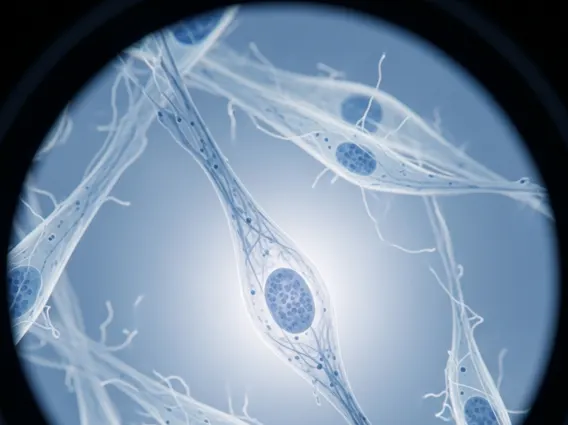
Fibrous Connective Tissue is a fundamental type of connective tissue in the human body, distinguished by its high concentration of protein fibers, primarily collagen, and sometimes elastic fibers. These fibers are synthesized and secreted by cells called fibroblasts, which are the most common cell type within this tissue. The dense arrangement of these fibers, along with a relatively sparse ground substance (the extracellular matrix that fills spaces between cells and fibers), endows fibrous connective tissue with remarkable tensile strength and elasticity. This robust composition enables it to withstand significant mechanical stress and tension, making it essential for structural support and the connection of various body parts. It plays a pivotal role in maintaining the integrity and function of numerous anatomical structures.
Functions and Types of Fibrous Connective Tissue
The multifaceted fibrous connective tissue function primarily involves providing mechanical support, connecting different tissues, and offering protection. This tissue forms the crucial structural framework for many organs and body parts, allowing them to retain their shape, resist deformation, and perform their specific roles effectively. Its strength is vital for transmitting forces generated by muscles, resisting stretching, and creating a resilient yet flexible framework throughout the musculoskeletal system.
There are two principal types of fibrous connective tissue, categorized by the organization of their collagen fibers:
- Dense Regular Connective Tissue: Characterized by collagen fibers that are densely packed and aligned in parallel bundles. This highly organized arrangement provides exceptional tensile strength when force is applied in a single direction. This makes it perfectly suited for structures like tendons, which connect muscles to bones, and ligaments, which connect bones to other bones, both of which experience unidirectional stress.
- Dense Irregular Connective Tissue: In contrast, this type features collagen fibers that are densely packed but interwoven into a haphazard, irregular network. This less organized structure allows the tissue to withstand tension and stress from multiple directions, providing strength and resistance to tearing across various planes. It is predominantly found in areas requiring multi-directional resilience, such as the deep layers of the dermis of the skin, the fibrous capsules surrounding organs (e.g., kidneys, spleen), and the protective coverings of joints.
Where is Fibrous Connective Tissue Found?
The widespread distribution of fibrous connective tissue is found throughout the human body, highlighting its indispensable role in structural integrity and mechanical function. Its presence is critical in regions demanding substantial strength, resilience, and the ability to connect disparate anatomical components.
Key locations where this vital tissue is prevalent include:
- Tendons: These robust, cord-like structures are composed of dense regular connective tissue, effectively linking muscles to bones and enabling the transmission of muscle contractions for movement.
- Ligaments: Also made of dense regular connective tissue, ligaments connect bones to other bones, providing stability to joints and preventing excessive or undesirable movements.
- Dermis of the Skin: The underlying layer of the skin, the dermis, is rich in dense irregular connective tissue. This provides the skin with its characteristic strength, elasticity, and resistance to tearing, protecting underlying structures.
- Organ Capsules: Many vital internal organs, including the kidneys, spleen, and liver, are encased in tough, protective fibrous capsules. These capsules, primarily dense irregular connective tissue, shield the organs from physical trauma and help maintain their shape.
- Periosteum and Perichondrium: The periosteum is a fibrous membrane covering the outer surface of bones, except at articular surfaces, while the perichondrium covers cartilage. Both serve protective functions and provide attachment points for muscles, tendons, and ligaments.
- Fascia: This broad term refers to sheets of fibrous connective tissue that enclose muscles, groups of muscles, blood vessels, and nerves, binding some structures together while permitting others to slide smoothly over each other.
This extensive presence underscores the critical contribution of fibrous connective tissue to the overall architecture, stability, and functional capacity of the human organism.