Fibroblast
Fibroblasts are crucial cells found in connective tissue throughout the body, playing a fundamental role in maintaining tissue structure and facilitating repair processes. These versatile cells are essential for the synthesis and organization of the extracellular matrix.
Key Takeaways
- Fibroblasts are the primary cells of connective tissue, responsible for producing the extracellular matrix.
- They synthesize vital components like collagen, elastin, and glycosaminoglycans, which provide structural support to tissues.
- These cells are crucial for maintaining tissue integrity and play a central role in the body’s wound healing response.
- During injury, fibroblasts transform into myofibroblasts, actively contracting wounds and forming scar tissue.
- Understanding fibroblast function is key to developing treatments for fibrosis, scarring, and regenerative medicine.
What is a Fibroblast?
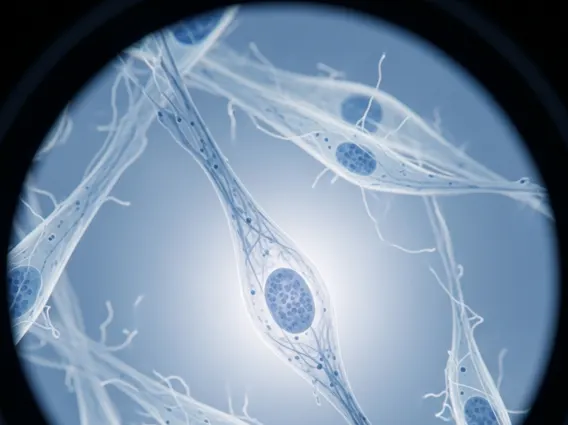
A Fibroblast is a type of cell that synthesizes the extracellular matrix and collagen, the structural framework (stroma) for animal tissues. These cells are the most common cells of connective tissue in animals. Essentially, fibroblast cells explained are the workhorses behind the physical integrity and elasticity of our organs and skin. They are spindle-shaped cells with a branched cytoplasm surrounding an oval, flattened nucleus, often exhibiting prominent nucleoli.
Fibroblasts originate from mesenchymal stem cells and are widely distributed throughout the body, residing in various connective tissues such as the dermis of the skin, tendons, ligaments, and internal organs. Their primary function is to maintain the structural integrity of these tissues by continuously producing and remodeling the extracellular matrix (ECM). This dynamic environment is critical for cell adhesion, communication, and differentiation, influencing numerous physiological processes.
Fibroblast Function and Types
The core fibroblast function and types are centered around their ability to synthesize and secrete components of the extracellular matrix. This includes various types of collagen, which provides tensile strength; elastin, which imparts elasticity; and proteoglycans and glycosaminoglycans, which contribute to tissue hydration and resilience. Through these secretions, fibroblasts create a complex network that supports cells, provides mechanical strength, and facilitates nutrient and waste exchange within tissues.
Fibroblasts exist in different states and can differentiate into specialized forms depending on physiological demands. While often considered a single cell type, their activity and morphology can vary. Key functional aspects include:
- Matrix Production: Synthesizing collagen (types I, III, V), elastin, fibronectin, and other glycoproteins.
- Matrix Remodeling: Secreting enzymes like matrix metalloproteinases (MMPs) to degrade old matrix components, allowing for tissue repair and regeneration.
- Growth Factor Secretion: Producing growth factors that influence the proliferation and differentiation of other cells.
- Mechanosensing: Responding to mechanical cues from their environment, which can alter their gene expression and behavior.
When activated, particularly during wound healing, fibroblasts can differentiate into myofibroblasts. These specialized cells possess contractile properties, similar to smooth muscle cells, and play a critical role in wound closure.
Fibroblast’s Critical Role in Tissue Repair
The fibroblast role in tissue repair is indispensable, making them central players in the body’s response to injury and disease. Following tissue damage, fibroblasts are rapidly activated and migrate to the site of injury. Here, they undergo proliferation and differentiation, transforming into myofibroblasts, which are characterized by the expression of alpha-smooth muscle actin (α-SMA) and increased contractile capabilities.
Myofibroblasts are responsible for contracting the wound edges, thereby reducing the size of the defect. Concurrently, they deposit large amounts of new extracellular matrix components, particularly collagen, to form granulation tissue. This process eventually leads to the formation of scar tissue, which provides structural integrity to the injured area but can sometimes result in fibrosis if the process is dysregulated. While essential for healing, excessive fibroblast activity can contribute to pathological conditions such as keloids, hypertrophic scars, and organ fibrosis, highlighting the delicate balance required for effective tissue repair.