Calcium Ca 46 Chloride Aqueous Solution
Calcium Ca 46 Chloride Aqueous Solution refers to a specialized chemical compound utilized primarily within specific medical, clinical, and research contexts. Its unique isotopic composition distinguishes it from common calcium chloride solutions, making it valuable for particular diagnostic and investigative applications.
Key Takeaways
- Calcium Ca 46 Chloride Aqueous Solution is a specialized, isotopically enriched form of calcium chloride.
- It is used in medical and clinical research, particularly for studying calcium metabolism and absorption.
- The “Ca 46” denotes a stable, non-radioactive isotope of calcium, allowing for precise tracking without radiation exposure.
- Its properties include high solubility in water and a well-defined chemical formula.
- Applications range from nutritional studies to bone health research and diagnostic testing.
What is Calcium Ca 46 Chloride Aqueous Solution?
Calcium Ca 46 Chloride Aqueous Solution is a stable isotope tracer used extensively in biomedical research and clinical diagnostics. Unlike naturally occurring calcium, which is a mixture of several isotopes, this solution specifically contains calcium enriched with the isotope 46Ca. This enrichment allows researchers to differentiate it from endogenous calcium within biological systems. The term “aqueous solution” signifies that the compound is dissolved in water, forming a clear, stable liquid suitable for administration or experimental use. Its primary purpose is to provide a non-radioactive method for tracking calcium pathways in the body, offering a safer alternative to radioactive isotopes for long-term studies or use in vulnerable populations, such as children or pregnant individuals.
The precise nature of what is Calcium Ca 46 Chloride aqueous makes it an invaluable tool for understanding complex physiological processes. It enables detailed investigations into calcium absorption, distribution, excretion, and its role in various metabolic disorders. By administering a known quantity of this isotopically labeled calcium and then measuring its presence in blood, urine, or tissue samples, scientists can gain insights into calcium kinetics without altering the body’s natural calcium pool or exposing subjects to ionizing radiation.
Properties and Chemical Formula of Calcium Ca 46 Chloride Solution
The Calcium Ca 46 Chloride solution properties are largely consistent with those of standard calcium chloride, with the critical distinction being the isotopic composition of the calcium ion. It typically presents as a clear, colorless liquid when dissolved in water. Calcium chloride (CaCl2) is highly soluble in water, a characteristic that is maintained in its isotopically enriched form. This high solubility ensures that the solution can be easily prepared and administered in various concentrations, making it versatile for different research protocols.
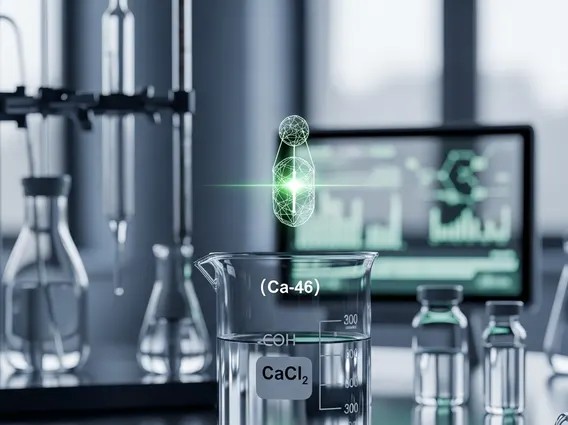
The Calcium Ca 46 Chloride aqueous formula is essentially 46CaCl2 dissolved in H2O. The calcium ion (Ca2+) in this specific solution has an atomic mass of 46, rather than the more abundant 40. This isotopic difference is detectable using advanced analytical techniques such as mass spectrometry, which can distinguish between isotopes based on their mass-to-charge ratio. Key properties include:
- Solubility: Highly soluble in water, forming a stable aqueous solution.
- Isotopic Purity: Enriched with the stable isotope 46Ca, typically to a high percentage.
- Stability: Chemically stable under normal storage conditions.
- Non-radioactive: 46Ca is a stable isotope, meaning it does not decay radioactively, ensuring safety for biological studies.
- pH: Aqueous solutions of calcium chloride are generally neutral to slightly alkaline.
These properties make it an ideal tracer for precise and safe investigations into calcium metabolism without the risks associated with radioactive materials.
Applications and Uses of Calcium Ca 46 Chloride Solution
The uses of Calcium Ca 46 Chloride solution are diverse, primarily centered around its role as a stable isotope tracer in medical and nutritional sciences. Its non-radioactive nature allows for repeated measurements and long-term studies, which is crucial for understanding chronic conditions or developmental processes. This solution is particularly valuable in scenarios where radiation exposure must be minimized or avoided entirely.
Some prominent applications include:
- Nutritional Studies: Assessing calcium absorption and bioavailability from different dietary sources or supplements in humans and animals. This helps in understanding the effectiveness of various calcium interventions.
- Bone Metabolism Research: Investigating bone turnover rates, calcium deposition in bone, and the impact of diseases like osteoporosis or treatments on bone health.
- Pediatric Research: Safely studying calcium kinetics in infants and children, where radioactive tracers are generally contraindicated.
- Renal Physiology: Examining calcium excretion and reabsorption by the kidneys, providing insights into kidney function and disorders affecting calcium balance.
- Pharmacokinetic Studies: Evaluating the absorption and distribution of calcium-containing drugs or therapies.
By providing a precise and safe method to track calcium, Calcium Ca 46 Chloride Aqueous Solution significantly contributes to advancements in understanding human physiology, improving diagnostic capabilities, and developing more effective treatments for calcium-related health issues.