Retiform Hemangioendothelioma
Retiform hemangioendothelioma is a rare, low-grade vascular tumor that typically affects the skin and subcutaneous tissues. Understanding this condition is crucial for accurate diagnosis and effective management.

Key Takeaways
- Retiform hemangioendothelioma is a rare, slow-growing vascular tumor primarily affecting the skin.
- It is characterized by a distinctive “retiform” or net-like growth pattern of endothelial cells.
- Symptoms often include a solitary, firm, reddish-brown nodule or plaque, commonly on extremities.
- Diagnosis relies on histopathological examination of a biopsy, revealing its unique microscopic features.
- Treatment typically involves complete surgical excision, with recurrence possible if removal is incomplete.
What is Retiform Hemangioendothelioma?
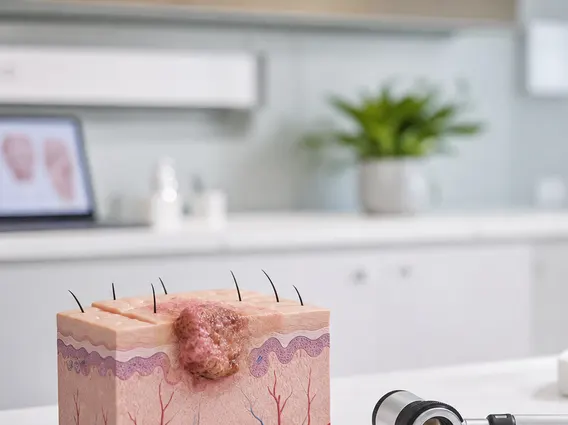
Retiform hemangioendothelioma is a distinct type of vascular tumor characterized by its unique microscopic appearance, resembling a network of elongated, branching blood vessels. This rare neoplasm is classified as an intermediate-grade tumor, meaning it has a low potential for aggressive behavior but can recur locally if not completely removed. It predominantly affects the dermis and subcutis, often presenting as a slow-growing lesion.
First described in 1994, this tumor is considered part of the broader spectrum of hemangioendotheliomas, which are vascular tumors with features intermediate between benign hemangiomas and malignant angiosarcomas. While it can occur at any age, it is more commonly observed in young adults and typically presents as a solitary lesion. Its rarity means that comprehensive epidemiological data are limited, but it is recognized globally by dermatopathologists and oncologists.
Symptoms of Retiform Hemangioendothelioma
The clinical presentation of Retiform Hemangioendothelioma is often subtle and non-specific, which can sometimes lead to diagnostic delays. The most common manifestation is a slowly enlarging lesion on the skin or in the subcutaneous tissue. Individuals experiencing retiform hemangioendothelioma symptoms typically notice a solitary, firm, reddish-brown to violaceous nodule or plaque.
These lesions are most frequently found on the extremities, particularly the distal parts, such as the hands, feet, and lower legs. Less commonly, they can appear on the trunk or head and neck region. While usually asymptomatic, some patients may report mild tenderness or pain, especially if the lesion is subject to trauma or pressure. The slow growth rate means that patients might have the lesion for months or even years before seeking medical attention. Key characteristics often include:
- Appearance: A firm, well-defined nodule or plaque.
- Color: Ranging from red to brown or purple.
- Location: Predominantly on the limbs, especially distal extremities.
- Growth: Typically slow and progressive.
- Associated sensations: Usually asymptomatic, but can be mildly tender.
Causes and Treatment for Retiform Hemangioendothelioma
The exact retiform hemangioendothelioma causes are not fully understood. Like many rare tumors, it is believed to arise from endothelial cells, which line blood vessels, due to genetic or acquired cellular alterations. There is no clear association with specific environmental exposures, genetic predispositions, or viral infections identified to date. Research into the molecular pathways involved in its development is ongoing, aiming to uncover potential triggers or risk factors. Currently, most cases are considered sporadic, meaning they occur without a clear hereditary pattern or identifiable cause.
The primary and most effective retiform hemangioendothelioma treatment is complete surgical excision. Given its low-grade nature and tendency for local recurrence if incompletely removed, wide local excision with clear margins is crucial. The goal is to remove the entire tumor to prevent it from growing back in the same area. Following surgery, regular follow-up appointments are recommended to monitor for any signs of recurrence. In cases where complete surgical removal is challenging due to the lesion’s size or location, or if local recurrence occurs, other treatment modalities such as radiation therapy might be considered, though these are less common and typically reserved for specific situations. According to a review published in the Journal of Cutaneous Pathology, complete surgical removal leads to excellent long-term outcomes for most patients, with a low rate of metastasis.