Glycolysis
Glycolysis is a fundamental metabolic pathway that plays a crucial role in cellular respiration, serving as the initial step in breaking down glucose for energy production in nearly all living organisms.
Key Takeaways
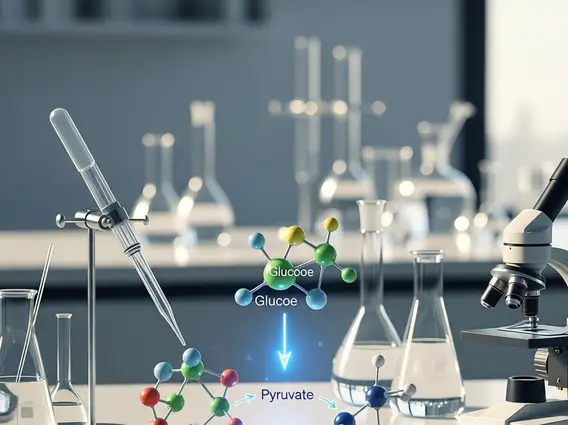
- Glycolysis is the metabolic process that breaks down a six-carbon glucose molecule into two three-carbon pyruvate molecules.
- Its core function is to generate immediate energy in the form of ATP and electron carriers (NADH) for cellular activities.
- The pathway operates in the cytoplasm and does not require oxygen, making it vital for both aerobic and anaerobic metabolism.
- It involves ten distinct enzymatic reactions, categorized into an energy-investment phase and an energy-payoff phase.
- The net products per glucose molecule are two ATP, two NADH, and two pyruvate, which can then enter further metabolic pathways for greater energy yield or fermentation.
What is Glycolysis and Its Core Function?
Glycolysis is a ubiquitous metabolic pathway found in the cytoplasm of virtually all living cells, from bacteria to humans. It represents the initial and most ancient stage of cellular respiration, responsible for initiating the breakdown of glucose to extract usable energy. This pathway is unique in its ability to function both in the presence (aerobic conditions) and absence (anaerobic conditions) of oxygen, making it an indispensable process for life across diverse environments and a cornerstone of metabolism.
The central objective of glycolysis is to convert one molecule of glucose, a six-carbon sugar, into two molecules of pyruvate, a three-carbon compound. This conversion is accompanied by the net production of adenosine triphosphate (ATP), the cell’s primary energy currency, and nicotinamide adenine dinucleotide (NADH), an electron carrier. The profound glycolysis definition and importance stem from its critical role in providing rapid energy for cellular functions, especially during periods of high energy demand or when oxygen supply is limited. Furthermore, the pyruvate produced can be further metabolized to generate significantly more ATP through the citric acid cycle and oxidative phosphorylation in aerobic conditions, or converted to lactate or ethanol in anaerobic conditions to regenerate NAD+ for continued glycolysis.
The Steps and Products of Glycolysis
The glycolytic pathway is a meticulously orchestrated sequence of ten enzyme-catalyzed reactions, traditionally divided into two distinct phases: the energy-investment phase and the energy-payoff phase. These phases work in concert to efficiently dismantle glucose and capture its chemical energy, ensuring a continuous supply for cellular needs.
The energy-investment phase begins with the phosphorylation of glucose, consuming two molecules of ATP. This initial energy input serves to trap glucose within the cell and destabilize the molecule, preparing it for subsequent cleavage. Glucose is converted through several intermediates, including glucose-6-phosphate and fructose-6-phosphate, ultimately yielding two molecules of glyceraldehyde-3-phosphate (G3P) after the splitting of fructose-1,6-bisphosphate. This phase is crucial for committing glucose to the glycolytic pathway and ensuring its irreversible breakdown.
Following the investment phase, the energy-payoff phase commences, processing the two G3P molecules. This phase involves a series of oxidation and phosphorylation reactions that generate energy. Specifically, four molecules of ATP are produced through substrate-level phosphorylation, and two molecules of NADH are formed as electrons are captured during the oxidation of G3P. The final product of this phase, and of glycolysis overall, is two molecules of pyruvate. These glycolysis steps and products represent the foundational output for subsequent metabolic processes, determining whether the cell proceeds with aerobic respiration for maximal energy extraction or fermentation to sustain ATP production under anaerobic conditions.
| Phase | Key Events | Net Products (per glucose) |
|---|---|---|
| Energy-Investment Phase | Glucose phosphorylation, isomerization, and cleavage into two 3-carbon molecules (G3P). | -2 ATP (consumed) |
| Energy-Payoff Phase | Oxidation of G3P, ATP generation via substrate-level phosphorylation, and pyruvate formation. | +4 ATP, +2 NADH, +2 Pyruvate |
| Overall Glycolysis | Complete conversion of one glucose molecule to two pyruvate molecules. | Net +2 ATP, +2 NADH, +2 Pyruvate |