Tomotherapy
Tomotherapy represents an advanced form of radiation therapy used in cancer treatment, combining intensity-modulated radiation therapy (IMRT) with daily CT imaging. This innovative approach allows for highly precise and individualized treatment delivery, targeting tumors while minimizing exposure to surrounding healthy tissues.
Key Takeaways
- Tomotherapy integrates radiation delivery with daily imaging for exceptional precision in cancer treatment.
- It uses a helical delivery system, allowing radiation to be delivered from 360 degrees around the patient.
- This technology precisely targets tumors, even those with complex shapes or located near critical organs.
- Benefits include reduced side effects, improved dose distribution, and adaptability to tumor changes.
- It is suitable for a wide range of cancers, from small, localized tumors to large, complex ones.
What is Tomotherapy?
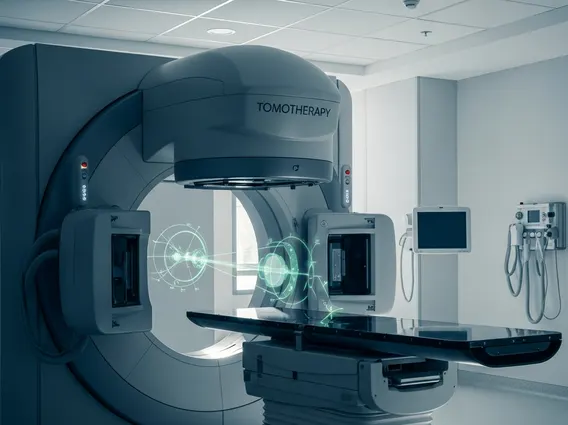
Tomotherapy is a sophisticated type of radiation therapy that delivers highly conformal radiation doses to tumors. It integrates a linear accelerator (linac) with a CT scanner, allowing for daily image-guided radiation therapy (IGRT). This integration ensures that radiation is delivered with exceptional accuracy, adapting to changes in tumor size or position throughout the course of treatment. The system operates by rotating around the patient, delivering radiation slices from various angles, similar to how a CT scanner acquires images.
This advanced method is designed to treat a wide range of cancers, including those that are challenging to target with conventional radiation techniques due to their location or irregular shape. The precision offered by Tomotherapy helps oncologists maximize the radiation dose to the cancerous cells while significantly reducing the dose to nearby healthy organs and tissues, thereby minimizing potential side effects. According to the American Society for Radiation Oncology (ASTRO), radiation therapy is a cornerstone of cancer treatment, with over half of all cancer patients receiving it at some point during their illness.
Key features of Tomotherapy include:
- Integrated Imaging: Daily CT scans before each treatment session verify tumor position and patient setup.
- Helical Delivery: Radiation is delivered continuously in a spiral pattern, allowing for comprehensive coverage.
- Intensity Modulation: The intensity of the radiation beam can be adjusted during treatment to conform precisely to the tumor’s shape.
- Adaptive Planning: Treatment plans can be adjusted during the course of therapy to account for changes in tumor size or patient anatomy.
How Tomotherapy Works for Cancer Treatment
Tomotherapy works for cancer treatment by combining the principles of intensity-modulated radiation therapy (IMRT) with image-guided radiation therapy (IGRT). Before each treatment session, a low-dose CT scan is performed directly on the Tomotherapy machine. This daily imaging allows the medical team to verify the exact position of the tumor and surrounding organs, ensuring that the radiation is delivered precisely where it is needed. If any shifts in position are detected, the treatment plan can be adjusted in real-time, a process known as adaptive radiation therapy.
Once the patient’s position is confirmed, the machine begins to deliver radiation. The linear accelerator, which produces the radiation, is mounted on a ring that rotates 360 degrees around the patient, similar to a CT scanner. As it rotates, the radiation beam is modulated in intensity and delivered in thin, fan-shaped beams. This helical delivery pattern allows for highly conformal dose distribution, sculpting the radiation dose to match the complex shape of the tumor. This meticulous approach ensures that even irregularly shaped tumors or those located close to sensitive structures receive the prescribed dose, while healthy tissues are spared as much as possible.
Benefits of Tomotherapy Radiation Therapy
The application of Tomotherapy radiation therapy explained through its advanced capabilities offers several significant advantages for cancer patients. One of the primary advantages is its unparalleled precision. By integrating daily CT imaging, the system can accurately target tumors, even those that move with breathing or are located in challenging anatomical areas. This precision translates into a higher dose delivered to the tumor and a lower dose to healthy tissues, which is crucial for reducing treatment-related side effects.
The ability to deliver radiation from 360 degrees with intensity modulation means that the radiation dose can be finely sculpted around the tumor, minimizing hot spots in healthy tissue and ensuring uniform coverage of the target volume. These **tomotherapy treatment benefits** contribute to improved patient outcomes and quality of life during and after treatment. Patients often experience fewer and less severe side effects compared to conventional radiation therapies, which can lead to better tolerance of the full treatment course.
Other notable benefits include:
- Reduced Toxicity: Lower radiation exposure to critical organs like the heart, lungs, or spinal cord.
- Versatility: Capable of treating a wide range of cancers, from single small lesions to large, complex, or multiple tumor sites.
- Adaptive Treatment: The ability to adjust treatment plans daily ensures optimal targeting throughout the entire course, accommodating changes in tumor size or patient anatomy.
- Improved Dose Homogeneity: Delivers a more uniform dose within the target volume, which can enhance tumor control.