Stomach Cancer Stages
Understanding the stages of stomach cancer is crucial for patients and healthcare providers alike, as it dictates treatment strategies and influences prognosis. This guide provides comprehensive stomach cancer stages information, detailing how the disease progresses and what each stage signifies.
Key Takeaways
- Stomach cancer stages are determined using the TNM system, which assesses tumor size (T), lymph node involvement (N), and distant metastasis (M).
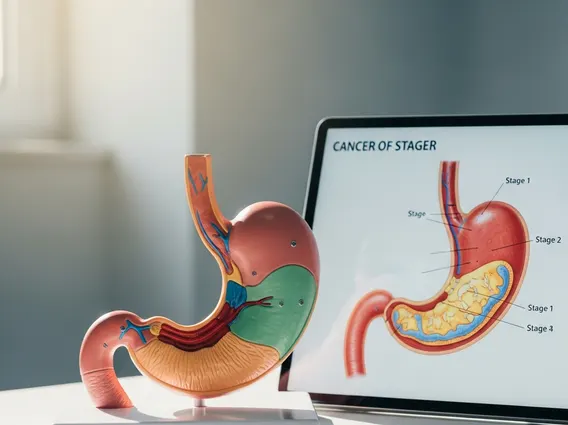
- Staging helps classify the extent of the cancer, ranging from Stage 0 (carcinoma in situ) to Stage IV (metastatic disease).
- Early detection, typically in Stages 0 or I, offers the best prognosis and a wider range of effective treatment options.
- Treatment approaches and stomach cancer prognosis by stage vary significantly, becoming more complex as the cancer advances.
- A thorough understanding of these stages is essential for informed decision-making regarding treatment and care.
What Are the Stages of Gastric Cancer?
The process of determining what are the stages of gastric cancer is a critical step following diagnosis. Staging is a standardized method used by medical professionals to describe the extent of cancer within the body. It indicates how large the primary tumor is, whether it has spread to nearby lymph nodes, and if it has metastasized to distant organs.
This detailed classification helps doctors develop the most appropriate treatment plan, predict the likely course of the disease, and provide an accurate prognosis. Without a clear understanding of the stomach cancer stages information, it would be challenging to tailor effective interventions. The staging process typically involves a combination of imaging tests, endoscopic procedures, and sometimes surgical exploration to gather all necessary data.
The Gastric Cancer Staging System (TNM)
The most widely accepted method for staging stomach cancer is the American Joint Committee on Cancer (AJCC) TNM system. This comprehensive gastric cancer staging system evaluates three key factors, which are then combined to assign an overall stage from 0 to IV. Each component provides specific details about the cancer’s characteristics, allowing for a precise classification.
The TNM system is vital for consistent communication among healthcare providers and for guiding research into new treatments. By standardizing how cancer is described, it ensures that patients receive comparable care and that outcomes can be accurately measured across different institutions.
Tumor (T), Node (N), Metastasis (M) Components
The TNM system breaks down the cancer’s extent into three distinct components:
- Tumor (T): This describes the size and extent of the primary tumor. It indicates how deeply the cancer has grown into the stomach wall and whether it has spread to nearby tissues or organs. Categories range from Tis (carcinoma in situ, meaning cancer cells are only in the innermost layer) to T4 (cancer has grown through all layers of the stomach and into nearby organs).
- Node (N): This refers to whether the cancer has spread to regional lymph nodes, which are small, bean-shaped glands that are part of the immune system. Categories range from N0 (no regional lymph node involvement) to N3 (extensive involvement of regional lymph nodes).
- Metastasis (M): This indicates whether the cancer has spread to distant parts of the body, such as the liver, lungs, or peritoneum. M0 means no distant metastasis, while M1 signifies that distant metastasis has occurred.
These three factors are then combined to determine the overall stomach cancer stages. For instance, a small tumor confined to the stomach lining with no lymph node involvement and no distant spread would be an early stage, whereas a large tumor with extensive lymph node involvement and distant spread would be an advanced stage.
Understanding Each Stomach Cancer Stage
Understanding stomach cancer stages involves recognizing how the TNM components translate into a numbered stage, from 0 to IV. Each stage represents a different level of cancer progression, impacting treatment options and prognosis. This stomach cancer stage by stage guide helps to clarify the journey of the disease.
Early Stages (0 and I)
The early and advanced stomach cancer stages have vastly different implications for treatment and survival. Early detection is paramount for improving outcomes.
- Stage 0 (Carcinoma in Situ): This is the earliest form of stomach cancer. Cancer cells are found only in the innermost lining of the stomach (mucosa) and have not invaded deeper tissues. At this stage, the cancer is highly treatable, often with endoscopic removal or surgery, and the prognosis is excellent.
- Stage I: In Stage I, the cancer has grown deeper into the stomach wall but is still relatively localized. It may have spread to the submucosa or muscularis propria layers, and possibly to one or two nearby lymph nodes, but not to distant sites. Treatment typically involves surgery to remove the affected part of the stomach and nearby lymph nodes, sometimes followed by chemotherapy or radiation. The prognosis remains favorable compared to later stages.
The ability to detect stomach cancer at these early stages significantly increases the chances of successful treatment and long-term survival. Unfortunately, stomach cancer often presents with vague symptoms, leading to diagnosis at later stages.
Advanced Stages (II, III, and IV)
As cancer progresses, it moves into the more complex early and advanced stomach cancer stages, requiring more aggressive and multifaceted treatment approaches.
- Stage II: At Stage II, the cancer has grown deeper into the stomach wall, possibly reaching the serosa (outermost layer), or has spread to more regional lymph nodes (3 to 6 nodes), but without distant metastasis. Treatment often involves a combination of surgery, chemotherapy, and sometimes radiation therapy. The prognosis is still manageable but less favorable than Stage I.
- Stage III: Stage III indicates more extensive local or regional spread. The cancer may have deeply invaded the stomach wall and spread to many regional lymph nodes (7 or more), or it may have grown into nearby organs like the spleen, colon, or liver, without distant metastasis. Treatment is typically multimodal, involving surgery, extensive chemotherapy, and radiation. The goal is often to control the disease and improve quality of life, as cure rates decrease significantly.
- Stage IV: This is the most advanced stage of stomach cancer. At Stage IV, the cancer has metastasized, meaning it has spread to distant organs (e.g., liver, lungs, brain, or peritoneum) or to non-regional lymph nodes. Treatment at this stage is primarily palliative, focusing on managing symptoms, improving quality of life, and extending survival. Options may include chemotherapy, targeted therapy, immunotherapy, or radiation to specific sites. While a cure is rare, advancements in treatment can help manage the disease for a period.
Each progression in stomach cancer stages signifies a greater challenge in treatment and a more guarded prognosis, underscoring the importance of early diagnosis.
Prognosis and Treatment Approaches by Stage
The stomach cancer prognosis by stage is a critical factor in determining the course of treatment and what patients can expect regarding their long-term outlook. Generally, the earlier the stage at diagnosis, the better the prognosis and the higher the likelihood of successful treatment.
Treatment approaches are highly individualized but generally follow patterns based on the stage:
- Stage 0 and I: For these early stages, surgery is often the primary treatment, aiming to remove the tumor and a margin of healthy tissue, along with nearby lymph nodes. Endoscopic mucosal resection (EMR) or endoscopic submucosal dissection (ESD) may be options for very early, superficial tumors. Adjuvant chemotherapy or radiation may be considered to reduce recurrence risk.
- Stage II and III: Treatment for these stages typically involves a multimodal approach. This often includes surgery (partial or total gastrectomy), combined with chemotherapy and/or radiation therapy, either before (neoadjuvant) or after (adjuvant) surgery. The goal is to shrink the tumor, remove as much cancer as possible, and kill any remaining cancer cells.
- Stage IV: At this advanced stage, treatment focuses on palliative care, symptom management, and improving quality of life. Chemotherapy, targeted therapy, and immunotherapy are common options to slow cancer growth and alleviate symptoms. Surgery may be performed in specific cases to manage complications like blockages or bleeding, rather than to cure the cancer.
According to the American Cancer Society, the 5-year relative survival rate for localized stomach cancer (Stages 0 and I) is approximately 75%, dropping to 35% for regional spread (Stages II and III), and significantly lower at 7% for distant metastatic disease (Stage IV). These statistics highlight the profound impact of stomach cancer stages on survival rates and underscore the urgency of early detection and intervention.
Frequently Asked Questions
How is stomach cancer staged?
Stomach cancer is primarily staged using the TNM (Tumor, Node, Metastasis) system, which assesses the primary tumor’s size and depth of invasion, the extent of lymph node involvement, and whether the cancer has spread to distant organs. This information is gathered through various diagnostic tests, including endoscopy with biopsy, CT scans, PET scans, and sometimes exploratory surgery. The combined findings determine the overall stage, guiding treatment decisions.
What is the significance of early detection in stomach cancer?
Early detection of stomach cancer is crucial because it significantly improves the prognosis and expands treatment options. When diagnosed in its earliest stages (Stage 0 or I), the cancer is typically confined to the stomach lining or wall, making it highly treatable with surgery, often leading to a cure. As the cancer progresses to later stages, it becomes more challenging to treat, with lower survival rates and a higher likelihood of recurrence or metastasis.
Does stomach cancer always spread to other organs?
No, stomach cancer does not always spread to other organs. Whether it spreads depends entirely on its stage at diagnosis. In early stages (0 and I), the cancer is localized to the stomach and has not spread. However, if left untreated or if diagnosed at later stages (III and IV), the cancer cells can invade surrounding tissues, travel through the lymphatic system to regional lymph nodes, or enter the bloodstream to metastasize to distant organs like the liver, lungs, or bones.