Spinal Column
The spinal column, often referred to as the backbone, is a critical component of the human skeletal system, providing both structural support and vital protection for the central nervous system. Its complex design allows for a wide range of motion while safeguarding the delicate spinal cord.
Key Takeaways
- The Spinal Column is the central support structure of the body, extending from the skull to the pelvis.
- It primarily functions to protect the spinal cord and nerves, support the head and torso, and enable body movement.
- Composed of 33 vertebrae, intervertebral discs, and a network of ligaments and muscles, it is divided into five distinct regions.
- Its intricate anatomy provides both strength and flexibility, crucial for daily activities.
- Various conditions, from degenerative diseases to injuries, can affect the health and function of the spine.
What is the Spinal Column?
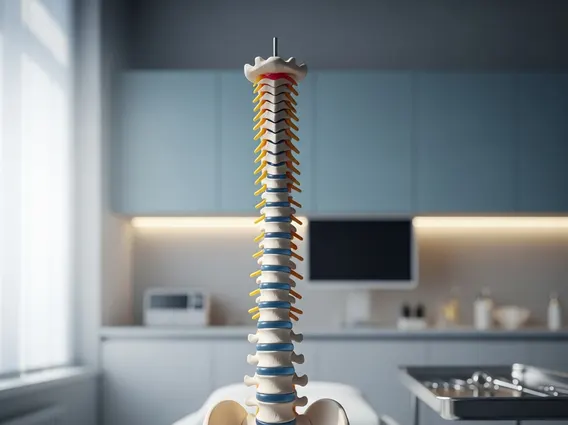
The Spinal Column is the central axis of the human skeleton, a flexible yet robust structure extending from the base of the skull down to the pelvis. It is a series of 33 individual bones, known as vertebrae, stacked upon one another and separated by intervertebral discs. This arrangement forms a protective canal for the spinal cord, which transmits nerve signals between the brain and the rest of the body.
Beyond its protective role, the spinal column bears the majority of the body’s weight, distributing forces evenly during movement and rest. Its unique curvature helps absorb shock and maintain balance, making it fundamental to posture and locomotion.
Structure and Role of the Human Spine
The anatomy of the human spine explained reveals a marvel of biomechanical engineering, designed for both strength and flexibility. It consists of vertebrae, intervertebral discs, ligaments, and muscles, all working in concert. The vertebrae are categorized into five distinct regions, each with specific characteristics and functions.
The different parts of the spinal column include:
| Region | Number of Vertebrae | Location | Primary Function |
|---|---|---|---|
| Cervical Spine | 7 (C1-C7) | Neck | Supports the head, allows head movement |
| Thoracic Spine | 12 (T1-T12) | Mid-back | Attaches to ribs, protects vital organs |
| Lumbar Spine | 5 (L1-L5) | Lower back | Bears most of the body’s weight, allows trunk movement |
| Sacrum | 5 (fused) | Pelvis | Connects spine to pelvis, provides stability |
| Coccyx | 4 (fused) | Tailbone | Minor weight-bearing, attachment point for muscles |
The intervertebral discs act as shock absorbers between the vertebrae, preventing bone-on-bone friction and allowing for spinal flexibility. Ligaments connect the vertebrae and help stabilize the column, while muscles provide movement and additional support.
The function of the spinal column is multifaceted, encompassing support, protection, and mobility. It serves as the primary support structure for the upper body, enabling us to stand upright, sit, and carry loads. Crucially, it encases and protects the delicate spinal cord, a vital pathway for nerve signals between the brain and the rest of the body. Furthermore, the spine’s segmental design, coupled with its natural curves, allows for a wide range of movements, including bending, twisting, and extending, essential for daily activities.
Common Spinal Conditions
The common conditions affecting the spine can range from acute injuries to chronic degenerative diseases, often leading to pain, reduced mobility, and neurological symptoms. These conditions can significantly impact an individual’s quality of life. According to the World Health Organization (WHO), low back pain is a very common condition, with a global point prevalence of 7.5%, meaning 577 million people were affected in 2017.
Some prevalent spinal conditions include:
- Herniated Discs: Occurs when the soft inner material of an intervertebral disc pushes through its tougher outer layer, potentially compressing nearby nerves.
- Scoliosis: An abnormal, sideways curvature of the spine, which can develop during childhood or adolescence and may require bracing or surgery in severe cases.
- Osteoarthritis: A degenerative joint disease affecting the cartilage in the facet joints of the spine, leading to pain, stiffness, and reduced flexibility.
- Spinal Stenosis: A narrowing of the spinal canal, which can put pressure on the spinal cord and nerves, causing pain, numbness, or weakness in the limbs.
- Spinal Fractures: Breaks in the vertebrae, often caused by trauma, osteoporosis, or certain medical conditions, leading to severe pain and potential neurological damage.
Effective management of these conditions often involves a combination of rest, physical therapy, medication, and, in some cases, surgical intervention, aiming to alleviate symptoms and restore function.