Skeletal
In a medical context, Skeletal refers to the framework of bones and cartilage that supports and protects the body, enabling movement and performing vital physiological functions. Understanding the skeletal system is fundamental to comprehending human anatomy and health.
Key Takeaways
- The human skeletal system provides structural support, protection for organs, and facilitates movement.
- It consists of 206 bones in adults, categorized into axial and appendicular skeletons.
- Key functions of the skeletal system include mineral storage, blood cell production, and endocrine regulation.
- Bones are classified into five main types of bones in the human body: long, short, flat, irregular, and sesamoid.
- Various skeletal system diseases and conditions, such as osteoporosis and arthritis, can significantly impact bone health and mobility.
What is the Human Skeletal System?
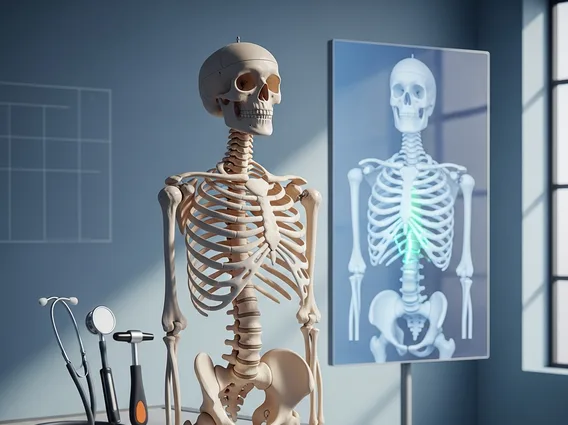
The human skeletal system is a complex biological framework comprising bones, cartilage, ligaments, and other connective tissues. It serves as the body’s primary support structure, protecting internal organs, anchoring muscles, and facilitating movement. In adults, this intricate system typically consists of 206 bones, which are living tissues that constantly remodel throughout life. Beyond its structural role, the skeletal system is crucial for various metabolic processes.
The skeletal system is broadly divided into two main parts: the axial skeleton and the appendicular skeleton. The axial skeleton includes the skull, vertebral column, and rib cage, providing central support and protecting the brain, spinal cord, and thoracic organs. The appendicular skeleton comprises the bones of the limbs and the girdles (pectoral and pelvic) that attach them to the axial skeleton, enabling a wide range of motion and locomotion.
Functions and Types of Bones in the Human Body
The functions of the skeletal system extend far beyond mere support and movement. It plays a critical role in several physiological processes essential for life. One primary function is the protection of vital organs; for example, the skull safeguards the brain, and the rib cage shields the heart and lungs. Bones also serve as a reservoir for essential minerals, particularly calcium and phosphorus, releasing them into the bloodstream as needed to maintain mineral homeostasis. Furthermore, the bone marrow within certain bones is responsible for hematopoiesis, the production of blood cells, including red blood cells, white blood cells, and platelets. The skeletal system also facilitates movement by providing attachment points for muscles, acting as levers that transmit muscle contractions into motion. Recent research also highlights its role in endocrine regulation, with bones producing hormones like osteocalcin that influence blood sugar regulation and fat deposition.
The types of bones in the human body are categorized based on their shape and function. Each type is uniquely adapted to perform specific roles within the body:
- Long Bones: Characterized by a shaft and two expanded ends, these bones are longer than they are wide. Examples include the femur (thigh bone) and humerus (upper arm bone), primarily functioning in movement and support.
- Short Bones: Roughly cube-shaped, these bones provide stability and some movement. They are found in the wrists (carpals) and ankles (tarsals).
- Flat Bones: Thin, flattened, and often curved, flat bones offer protection for internal organs and provide large areas for muscle attachment. Examples include the cranial bones, sternum (breastbone), and scapulae (shoulder blades).
- Irregular Bones: These bones have complex shapes that do not fit into the other categories. They often have specialized functions, such as the vertebrae (spinal bones) that protect the spinal cord and the facial bones.
- Sesamoid Bones: Small, round bones embedded within tendons, sesamoid bones protect tendons from stress and improve the mechanical advantage of muscles. The patella (kneecap) is the most prominent example.
Skeletal System Diseases and Conditions
The skeletal system, despite its robustness, is susceptible to various skeletal system diseases and conditions that can impair its function and significantly impact quality of life. These conditions range from degenerative disorders to genetic abnormalities and injuries. One of the most prevalent conditions is osteoporosis, a disease characterized by reduced bone density and structural deterioration, leading to increased fracture risk. Globally, osteoporosis affects an estimated 200 million women, and approximately one in three women and one in five men aged 50 and over will sustain an osteoporotic fracture in their lifetime, according to the International Osteoporosis Foundation.
Other common conditions include various forms of arthritis, such as osteoarthritis and rheumatoid arthritis, which involve inflammation and degradation of joints. Fractures, or breaks in bones, are also common injuries, often resulting from trauma or underlying bone weakness. Scoliosis, an abnormal curvature of the spine, can affect posture and lead to pain. Metabolic bone diseases like Paget’s disease and rickets (in children) or osteomalacia (in adults) disrupt bone remodeling and mineralization. Early diagnosis and appropriate management are crucial for mitigating the impact of these conditions and preserving skeletal health.