Radial Scar
A radial scar is a benign breast lesion characterized by a central fibrous core with radiating ducts and lobules. While not cancerous itself, its complex structure can sometimes mimic malignancy on imaging, necessitating careful evaluation.
Key Takeaways
- Radial Scar is a non-cancerous breast lesion with a distinctive star-like appearance.
- It is generally considered benign but can be associated with other atypical or malignant lesions.
- Diagnosis often requires a radial scar breast biopsy to differentiate it from cancer.
- Management typically involves surgical excision, though observation may be considered in specific, carefully evaluated cases.
- Its presence warrants close follow-up due to a slightly increased risk of associated breast cancer.
What is Radial Scar?
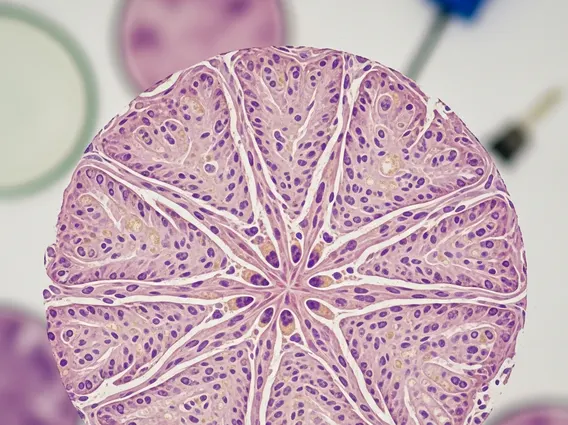
Radial Scar, also known as a complex sclerosing lesion, refers to a benign breast condition characterized by a central fibrous core from which ducts and lobules radiate outwards, creating a star-like or stellate appearance. This architectural distortion can often resemble invasive breast cancer on mammograms, making accurate diagnosis crucial. Microscopically, it involves a proliferation of normal breast tissue components, including epithelial cells, myoepithelial cells, and fibrous stroma, arranged in a distinctive pattern.
The exact cause of radial scars is not fully understood, but they are thought to arise from a localized area of tissue distortion and fibrosis. While they are not cancer, their significance lies in their ability to mimic malignancy radiologically and their potential association with other atypical proliferative lesions or even carcinoma in situ within or adjacent to the scar. Understanding the radial scar meaning and treatment begins with recognizing its benign nature while acknowledging its complex implications for breast health.
Is Radial Scar Dangerous?
While a radial scar itself is a benign (non-cancerous) lesion, the question of “is radial scar dangerous” stems from its complex nature and potential associations. Radial scars are not inherently dangerous in the sense of being cancerous, but they are considered a risk factor for developing breast cancer. Studies have shown that women diagnosed with a radial scar have a slightly increased risk of developing breast cancer over their lifetime, particularly if the scar is associated with atypical ductal hyperplasia (ADH) or lobular carcinoma in situ (LCIS).
The primary concern with radial scars is their ability to obscure or coexist with more serious lesions. Approximately 10-30% of radial scars are found to have associated atypical hyperplasia, ductal carcinoma in situ (DCIS), or even invasive carcinoma upon surgical excision. For this reason, many medical professionals recommend surgical removal of radial scars to ensure that no hidden malignancy is present. This proactive approach helps to definitively rule out cancer and manage any increased risk effectively.
Diagnosis and Management of Radial Scar
The diagnosis of a radial scar typically begins with imaging findings, most commonly on a mammogram, where it appears as a spiculated mass or architectural distortion that can be indistinguishable from cancer. Ultrasound and MRI may also be used to further characterize the lesion. Due to this ambiguity, a definitive diagnosis almost always requires a tissue sample.
A radial scar breast biopsy is the standard procedure for confirming the nature of the lesion. This can be performed as a core needle biopsy, guided by mammography, ultrasound, or MRI. However, because core needle biopsy can sometimes miss associated atypical cells or malignancy within a complex radial scar, surgical excisional biopsy is often recommended, especially if the core biopsy findings are discordant with imaging or show atypical features. The management approach considers the initial biopsy results, the size of the lesion, and the presence of any associated atypical cells or malignancy. For radial scars confirmed as benign without atypical features on excisional biopsy, routine surveillance is usually recommended. If atypical cells or cancer are found, further treatment tailored to those findings will be necessary.
Management options for radial scars include:
- Surgical Excision: This is often recommended to completely remove the lesion and ensure no hidden malignancy or atypical cells are missed, especially after a core needle biopsy.
- Observation: In select cases, particularly for small lesions diagnosed definitively as benign without atypical features on a high-quality core biopsy, close radiological follow-up may be considered as an alternative to surgery. This decision is made in consultation with a breast specialist.
- Genetic Counseling: For individuals with a strong family history of breast cancer or other risk factors, genetic counseling may be considered to assess overall breast cancer risk.
The ultimate goal of managing a radial scar is to accurately assess its nature and address any associated risks, ensuring optimal patient outcomes.