
Oral Papilloma
Oral Papilloma is a common, benign lesion that can develop in the mouth, often appearing as a small, cauliflower-like growth. While generally harmless, understanding its characteristics, causes, and treatment options is crucial for proper management and peace of mind.
Key Takeaways
- Oral Papilloma is a non-cancerous growth in the mouth, typically caused by the human papillomavirus (HPV).
- It often appears as a solitary, painless, cauliflower-like lesion on various oral surfaces.
- The condition is generally asymptomatic, but larger lesions can cause discomfort or interfere with oral functions.
- While HPV is contagious, the risk of transmission leading to Oral Papilloma is low, and the lesions themselves are not highly contagious.
- Treatment primarily involves surgical excision, which is usually curative, with a low recurrence rate.
What is Oral Papilloma?
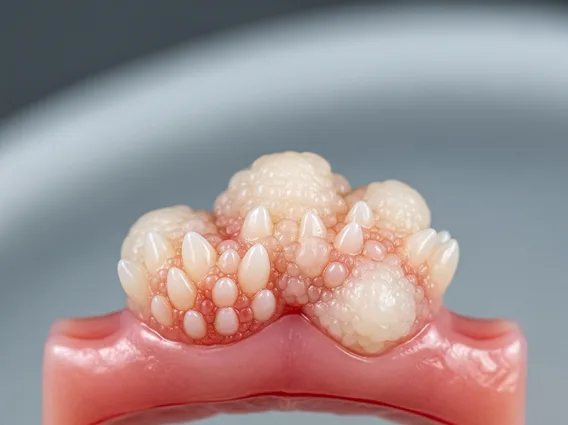
Oral Papilloma refers to a benign (non-cancerous) epithelial tumor that commonly occurs in the oral cavity. These lesions typically present as solitary, exophytic (outward-growing) masses with a rough, warty, or cauliflower-like surface, often attached to the oral mucosa by a narrow stalk. They can appear white, pink, or reddish, depending on the degree of keratinization and vascularity.
Oral Papillomas can develop on various surfaces within the mouth, including the tongue, lips, palate, gingiva, and buccal mucosa. While they are generally asymptomatic and painless, their presence can sometimes cause minor irritation or interfere with chewing or speech if they grow large or are located in high-friction areas. They are among the most common benign oral lesions, affecting individuals of all ages, though they are frequently observed in adults.
Oral Papilloma: Symptoms, Causes, and Contagion
Understanding the presentation and etiology of oral papillomas is essential for accurate diagnosis and patient education. The term oral papilloma symptoms and causes encompasses the characteristic appearance of these lesions and the underlying viral infection responsible for their development.
The primary symptom of an Oral Papilloma is the visible growth itself. These lesions are typically:
- Small, usually less than 1 cm in diameter.
- Soft to firm upon palpation.
- Attached to the oral tissue by a pedicle (stalk) or a broad base.
- White or pink, with a textured, often frond-like or “cauliflower” surface.
The main cause of Oral Papilloma is infection with the human papillomavirus (HPV), particularly low-risk types such as HPV-6 and HPV-11. HPV is a common virus, and oral HPV infections can occur through various forms of oral contact. According to the Centers for Disease Control and Prevention (CDC), about 7% of people aged 14–69 years in the United States have oral HPV, though not all infections lead to visible lesions like papillomas.
Regarding the question, “is oral papilloma contagious,” the underlying HPV infection is indeed transmissible. However, the lesions themselves are not considered highly contagious in the sense of direct contact with the papilloma immediately causing another lesion. Transmission of HPV typically occurs through skin-to-skin or mucous membrane-to-mucous membrane contact, often during sexual activity. While the virus can be spread, the development of a papilloma is a localized manifestation and does not imply a high risk of immediate transmission from casual contact with the lesion.
Treatment Options for Oral Papilloma
When considering “how to treat oral papilloma,” the primary approach involves surgical removal of the lesion. Before treatment, a definitive diagnosis is usually made through a biopsy, where a small tissue sample is taken and examined under a microscope to confirm its benign nature and rule out other conditions.
Once diagnosed, the most effective and common treatment for Oral Papilloma is complete surgical excision. This can be performed using a scalpel, laser ablation, or electrosurgery. The goal is to remove the entire lesion, including its base, to minimize the chance of recurrence. Surgical removal is typically a straightforward procedure, often performed under local anesthesia in an outpatient setting.
Following surgical removal, the prognosis is excellent, with a very low rate of recurrence. Patients are usually advised to maintain good oral hygiene and attend regular dental check-ups to monitor for any new lesions or other oral health concerns. While the lesion itself is benign, addressing the underlying HPV infection is not typically part of the treatment for the papilloma itself, as the body often clears the virus over time.



















