Mrsi
Magnetic Resonance Spectroscopic Imaging (MRSI) is an advanced medical imaging technique that provides detailed biochemical information about tissues. It is a powerful tool used in various clinical applications, particularly in oncology and neurology.
Key Takeaways
- Magnetic Resonance Spectroscopic Imaging (MRSI) is a non-invasive medical imaging technique that goes beyond anatomical structure.
- It provides crucial biochemical insights into tissue metabolism, detecting specific compounds like choline, creatine, and N-acetylaspartate.
- MRSI is primarily utilized in oncology for tumor characterization, grading, and monitoring treatment response, and in neurology for diagnosing and understanding brain disorders.
- The technique works by analyzing the unique magnetic resonance signals emitted by different metabolites within the body.
- It complements standard MRI by offering functional and metabolic information, enhancing diagnostic accuracy.
What is MRSI (Magnetic Resonance Spectroscopic Imaging)? Definition and Uses
Magnetic Resonance Spectroscopic Imaging (MRSI) is an advanced non-invasive MRSI medical imaging technique that combines the anatomical detail of magnetic resonance imaging (MRI) with the biochemical insights of spectroscopy. Unlike conventional MRI, which primarily visualizes water content and tissue structure, MRSI detects and quantifies specific metabolic compounds within tissues. This capability allows clinicians to gain a deeper understanding of tissue composition and function at a molecular level.
The core of the MRSI definition and uses lies in its ability to map the distribution of various metabolites, such as choline, creatine, N-acetylaspartate (NAA), and lactate. Changes in the concentrations of these metabolites can indicate disease processes, making MRSI particularly valuable in diagnosing and monitoring conditions that alter cellular metabolism. For instance, elevated choline often suggests increased cell membrane turnover, a hallmark of rapidly growing tumors, while reduced NAA can point to neuronal damage or loss.
MRSI is employed in a variety of clinical applications, significantly enhancing diagnostic capabilities:
- Oncology: It is widely used for brain tumor characterization, helping to differentiate between tumor types, assess tumor aggressiveness, and distinguish recurrent tumors from treatment-related changes (e.g., radiation necrosis). It also aids in guiding biopsies and planning radiation therapy.
- Neurology: MRSI assists in the diagnosis and understanding of various neurological disorders, including stroke, epilepsy, multiple sclerosis, and neurodegenerative diseases like Alzheimer’s and Parkinson’s. It can reveal metabolic abnormalities that precede structural changes visible on standard MRI.
- Prostate Cancer: In prostate imaging, MRSI helps in localizing and grading prostate cancer, providing metabolic maps that complement anatomical MRI findings.
By providing a metabolic fingerprint of tissues, MRSI offers a unique window into the biochemical processes underlying health and disease, making it an indispensable tool in modern medicine.
How Magnetic Resonance Spectroscopic Imaging (MRSI) Works
Understanding how MRSI works involves grasping its foundation in nuclear magnetic resonance principles. Similar to standard MRI, MRSI utilizes a powerful magnetic field and radiofrequency pulses. However, instead of focusing solely on the signal from water protons, MRSI is tuned to detect signals from other hydrogen-containing molecules (metabolites) present in much lower concentrations within the body. Each metabolite has a unique chemical environment, causing its hydrogen nuclei to resonate at slightly different frequencies when exposed to the magnetic field. This phenomenon is known as the chemical shift.
During an MRSI scan explanation, the scanner applies a series of radiofrequency pulses and magnetic field gradients to excite the nuclei of specific metabolites within a defined region of interest. After excitation, these nuclei emit faint radio signals as they return to their equilibrium state. The scanner then detects these signals, which are characterized by their frequency and intensity. A complex mathematical process, known as Fourier transformation, is applied to these signals to separate them into their individual frequency components. Each component corresponds to a specific metabolite, and its intensity reflects the concentration of that metabolite in the tissue.
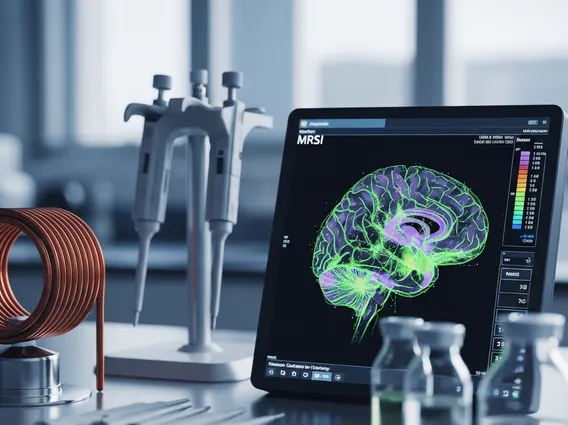
The data collected from different spatial locations within the scanned area are then processed to create a metabolic map or spectrum. This map visually represents the distribution and concentration of various metabolites across the tissue. For example, a map might highlight areas with elevated choline (indicating high cell turnover) or reduced NAA (suggesting neuronal damage). This detailed biochemical information, when overlaid with anatomical MRI images, provides a comprehensive view that aids clinicians in diagnosis, prognosis, and treatment planning, offering insights beyond what structural imaging alone can provide.