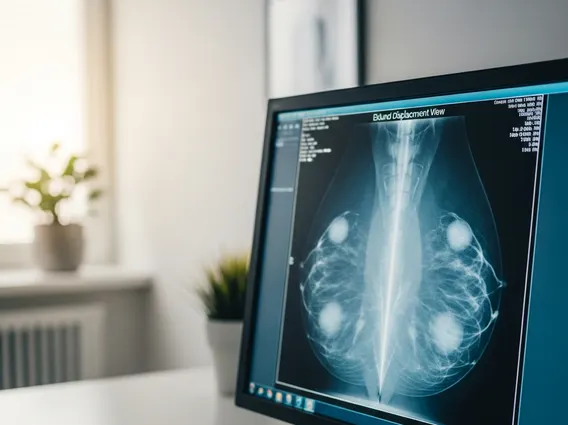
Eklund Displacement Views
Eklund Displacement Views are a specialized mammography technique crucial for effective breast cancer screening in individuals with breast implants. This method ensures comprehensive visualization of breast tissue that might otherwise be obscured by the implant.
Takeaways
- Eklund Displacement Views are specialized mammographic projections for individuals with breast implants.
- The technique involves gently displacing the implant posteriorly to isolate and compress the natural breast tissue.
- Its primary purpose is to improve the detection of potential abnormalities in the breast tissue.
- This method is vital for accurate breast cancer screening, as implants can obscure underlying tissue.
- It complements standard mammographic views, providing a more complete assessment of the breast.
What are Eklund Displacement Views?
Eklund Displacement Views refer to a specific set of mammographic projections designed to image the natural breast tissue of individuals who have breast implants. This specialized technique is critical because breast implants, whether saline or silicone, can obscure significant portions of the breast tissue on standard mammograms, potentially hiding cancerous lesions. The purpose of Eklund displacement views is to maximize the visualization of the glandular tissue by gently pushing the implant out of the field of view, allowing for better compression and imaging of the breast parenchyma. This method significantly enhances the diagnostic accuracy of mammography for this patient population, ensuring that crucial areas are not overlooked during screening. It is a fundamental part of breast cancer detection strategies for this demographic.
The procedure involves a skilled mammography technologist carefully manipulating the breast to push the implant posteriorly and superiorly towards the chest wall. This action isolates the natural breast tissue, which can then be compressed and imaged separately from the implant. By doing so, radiologists can obtain clearer images of the breast tissue, making it easier to identify subtle calcifications, suspicious masses, or architectural distortions that might indicate breast cancer. Without these specialized views, a substantial amount of breast tissue could go unexamined, potentially leading to delayed diagnoses and poorer outcomes. The technique is named after Dr. Donald Eklund, who pioneered this method to address the unique challenges of mammography in augmented breasts.
Eklund Technique for Breast Implant Mammography
The Eklund views mammography technique, also known as the implant displacement technique, is a standardized approach for performing mammograms on patients with breast implants. This technique is an essential component of comprehensive breast imaging protocols. It involves taking four additional views for each breast, beyond the standard two views (craniocaudal and mediolateral oblique), specifically designed to image the native breast tissue.
The steps involved in the Eklund method for breast implant imaging are precise and require careful execution:
- Implant Displacement: The technologist gently pushes the breast implant back towards the chest wall.
- Tissue Isolation: The natural breast tissue is pulled forward and away from the implant.
- Compression: The isolated breast tissue is then compressed and imaged, similar to a standard mammogram.
- Projection Types: Typically, two craniocaudal (top-to-bottom) and two mediolateral oblique (angle) views are taken for the displaced tissue.
This meticulous approach ensures that as much of the breast tissue as possible is visualized, reducing the risk of missing abnormalities. According to the American Cancer Society, regular mammography screening is recommended for women starting at age 40, and this recommendation extends to those with breast implants, necessitating specialized techniques like the Eklund views to ensure effective screening. While implants do not increase the risk of developing breast cancer, they can complicate its detection, making the Eklund technique indispensable.
Here’s a comparison of standard versus Eklund views:
| Feature | Standard Mammogram | Eklund Displacement Views |
|---|---|---|
| Primary Goal | Image entire breast tissue | Image natural breast tissue, displacing implant |
| Patient Population | General population | Individuals with breast implants |
| Implant Visibility | Implant often visible, obscuring tissue | Implant pushed out of view, tissue isolated |
| Number of Views (per breast) | Typically 2 (Craniocaudal, Mediolateral Oblique) | Typically 4 additional views (Craniocaudal, Mediolateral Oblique of displaced tissue) |
| Detection Efficacy | Reduced for implant patients without specialized views | Enhanced for implant patients |
The Eklund technique is a testament to advancements in medical imaging, ensuring that individuals with breast implants receive the same high standard of breast cancer screening as those without. It underscores the importance of tailored diagnostic approaches in modern healthcare.