Microfluidic Device
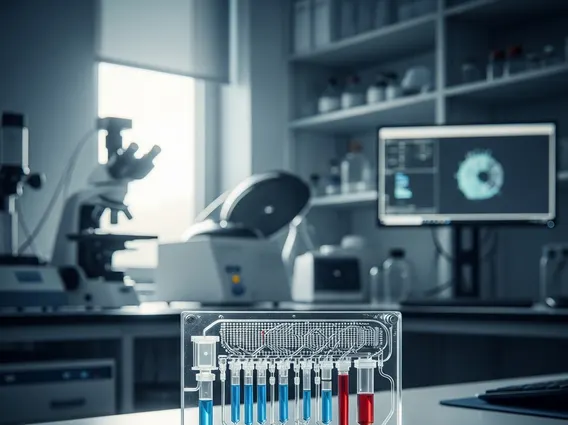
A Microfluidic Device represents a groundbreaking technology that manipulates and analyzes small volumes of fluids, typically in the picoliter to nanoliter range, within channels with dimensions from tens to hundreds of micrometers. This innovative approach has revolutionized various fields, particularly in medical diagnostics and research.
Key Takeaways
- A Microfluidic Device precisely controls and analyzes tiny fluid volumes within microscopic channels.
- These devices operate by leveraging unique fluid dynamics at the micro-scale, enabling precise sample handling.
- Common types include continuous-flow, droplet-based, and digital microfluidic systems, each suited for different applications.
- Key applications span point-of-care diagnostics, drug discovery, and advanced biological research.
- Their ability to miniaturize and automate processes offers significant advantages in efficiency and cost-effectiveness.
What is a Microfluidic Device?
A Microfluidic Device is a miniature laboratory on a chip, designed to handle and process fluids at the micro-scale. These devices typically feature intricate networks of channels, chambers, and other components fabricated on a substrate, often made of polymers, glass, or silicon. The fundamental principle behind these systems is the precise control over fluid flow, mixing, separation, and reaction within these tiny conduits.
The term Microfluidic Device refers to systems that exploit the unique physical and chemical properties of fluids when confined to micro-scale dimensions. At this scale, surface tension, viscous forces, and diffusion dominate over inertial forces, allowing for highly controlled and predictable fluid behavior. This enables researchers and clinicians to perform complex biochemical assays with minimal sample and reagent consumption, leading to faster results and reduced costs compared to traditional laboratory methods.
How Microfluidic Devices Work and Their Types
The operation of a Microfluidic Device hinges on the precise manipulation of fluids through various mechanisms, including pressure-driven flow, electrokinetic forces, and capillary action. These forces allow for the controlled movement, mixing, and separation of samples and reagents within the microchannels. For instance, pumps or external pressure sources can drive continuous fluid flow, while electric fields can move charged molecules or cells, enabling sophisticated analytical techniques.
Understanding how microfluidic devices work is crucial to appreciating their versatility. They often integrate multiple laboratory functions, such as sample preparation, reaction, separation, and detection, onto a single chip. This integration minimizes manual handling, reduces contamination risks, and accelerates experimental workflows. The field encompasses several distinct approaches, and the types of microfluidic devices explained below highlight their diverse operational principles:
- Continuous-Flow Microfluidics: Involves the steady, uninterrupted movement of fluids through channels. This type is often used for continuous chemical reactions, cell sorting, and separation processes where reagents are mixed and reacted as they flow.
- Droplet-Based Microfluidics: Utilizes immiscible fluids to create discrete droplets, each acting as an isolated reaction vessel. This allows for high-throughput screening, single-cell analysis, and the synthesis of nanoparticles, offering precise control over reaction volumes and conditions.
- Digital Microfluidics: Manipulates individual droplets on an array of electrodes through electrowetting-on-dielectric (EWOD) principles. This method offers extreme flexibility in reconfiguring fluidic pathways and performing complex operations by moving, splitting, and merging droplets electronically.
Key Applications of Microfluidic Devices
The impact of Microfluidic Device technology is far-reaching, transforming numerous sectors, particularly in healthcare and life sciences. The ability to perform complex analyses with minimal sample volumes and rapid turnaround times makes them invaluable. Some of the most significant microfluidic device applications include:
- Point-of-Care Diagnostics: Microfluidic devices enable rapid and portable diagnostic tests for various diseases, including infectious diseases, cancer biomarkers, and genetic conditions. Their compact size and ease of use make them ideal for resource-limited settings or emergency situations, providing quick results outside of traditional laboratory environments.
- Drug Discovery and Development: These devices are instrumental in high-throughput screening of drug candidates, toxicity testing, and creating organ-on-a-chip models. By mimicking human physiological conditions more accurately than conventional cell cultures, they accelerate the drug development process and reduce reliance on animal testing.
- Biological Research: Microfluidics facilitates advanced studies in cell biology, genomics, and proteomics. They allow for single-cell analysis, precise cell culture environments, and efficient separation of biomolecules, offering unprecedented insights into biological processes.
- Environmental Monitoring: Microfluidic systems are also employed for detecting pollutants in water and air, offering sensitive and rapid analysis crucial for public health and safety.
The continuous evolution of microfluidic technology promises even broader applications, further enhancing diagnostic capabilities, therapeutic interventions, and fundamental scientific understanding.