Platelet Derived Growth Factor
Platelet Derived Growth Factor (PDGF) is a crucial family of growth factors that plays a significant role in various physiological processes, including cell growth, division, and differentiation. Understanding its functions is vital for comprehending tissue repair and disease mechanisms.
Key Takeaways
- Platelet Derived Growth Factor (PDGF) is a protein that stimulates cell growth, division, and blood vessel formation.
- PDGF operates by binding to specific receptor tyrosine kinases on cell surfaces, initiating intracellular signaling pathways.
- The primary platelet derived growth factor function involves promoting cell proliferation, migration, and survival in various cell types.
- The role of PDGF in wound healing is critical, orchestrating processes like inflammation, new tissue formation, and remodeling.
- Dysregulation of PDGF signaling can contribute to the development of various diseases, including fibrosis and certain cancers.
What is Platelet Derived Growth Factor (PDGF)?
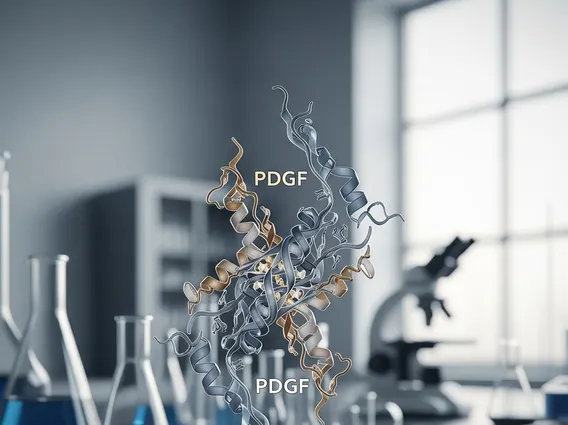
Platelet Derived Growth Factor (PDGF) refers to a family of dimeric proteins that are among the primary regulators of cell proliferation, migration, and angiogenesis. These growth factors are produced by various cell types, including platelets, macrophages, endothelial cells, and smooth muscle cells, and are stored in the alpha-granules of platelets, being released upon platelet activation. PDGF exists in five isoforms (PDGF-AA, PDGF-BB, PDGF-AB, PDGF-CC, and PDGF-DD), each composed of different combinations of two polypeptide chains (A, B, C, or D).
The biological activity of PDGF is mediated through its interaction with two distinct cell surface receptor tyrosine kinases, PDGF receptor alpha (PDGFRα) and PDGF receptor beta (PDGFRβ). These receptors are expressed on a wide range of mesenchymal cells, such as fibroblasts, smooth muscle cells, and glial cells, making them responsive to PDGF signaling. The specific isoform of PDGF determines which receptor it binds to, influencing the cellular response and the downstream signaling pathways activated.
Mechanism of Action and Cellular Functions of PDGF
The PDGF mechanism of action begins when a PDGF ligand binds to its specific receptor (PDGFRα or PDGFRβ) on the cell surface. This binding induces the dimerization of the receptors, leading to their autophosphorylation on specific tyrosine residues. These phosphorylated tyrosine residues then serve as docking sites for various intracellular signaling proteins, initiating a cascade of downstream events. Key signaling pathways activated include the PI3K/Akt pathway, the Ras/MAPK pathway, and the PLCγ pathway, which collectively regulate diverse cellular processes.
The comprehensive platelet derived growth factor function encompasses several critical cellular activities. It is a potent mitogen for mesenchymal cells, stimulating their proliferation, which is essential for tissue growth and repair. PDGF also promotes cell migration, guiding cells to sites of injury or development. Furthermore, it plays a vital role in cell survival by inhibiting apoptosis, and it contributes to angiogenesis, the formation of new blood vessels, by stimulating endothelial cell proliferation and migration. These functions are crucial for embryonic development, tissue homeostasis, and the body’s response to injury.
PDGF’s Role in Wound Healing and Tissue Repair
The role of PDGF in wound healing and tissue repair is fundamental and multifaceted, orchestrating several key processes from the initial inflammatory phase to tissue remodeling. Upon injury, platelets release PDGF, which acts as a chemoattractant for inflammatory cells like neutrophils and macrophages, drawing them to the wound site to clear debris and pathogens. Subsequently, PDGF stimulates the proliferation and migration of fibroblasts and smooth muscle cells, which are essential for generating new connective tissue and promoting wound contraction.
PDGF’s involvement in wound healing can be summarized by its actions in different stages:
- Inflammation: Released by activated platelets, it attracts inflammatory cells to the wound.
- Proliferation: Stimulates fibroblasts to synthesize collagen and other extracellular matrix components, forming granulation tissue.
- Angiogenesis: Promotes the formation of new blood vessels, ensuring adequate oxygen and nutrient supply to the healing tissue.
- Remodeling: Contributes to the maturation and reorganization of the newly formed tissue, leading to scar formation and eventual tissue strength.
By coordinating these cellular activities, PDGF ensures an efficient and effective repair process, highlighting its indispensable contribution to the body’s ability to recover from injury and maintain tissue integrity.