Pcr
Polymerase Chain Reaction (PCR) is a revolutionary molecular biology technique used to amplify a single copy or a few copies of a piece of DNA across several orders of magnitude, generating thousands to millions of copies of a particular DNA sequence.
Key Takeaways
- PCR is a fundamental technique that amplifies specific DNA segments for various applications.
- The process involves three main steps: denaturation, annealing, and extension, repeated multiple times.
- It is widely used in diagnostic testing for infectious diseases, genetic disorders, and cancer.
- Different types of PCR exist, such as RT-PCR for RNA detection and qPCR for quantitative analysis.
- Understanding PCR results is crucial for accurate diagnosis and research insights.
What is PCR (Polymerase Chain Reaction)?
Polymerase Chain Reaction (PCR) is a powerful laboratory technique that enables scientists to make millions of copies of a specific DNA segment from a very small initial sample. This amplification is crucial for various applications, especially when the amount of DNA available is too small to be analyzed directly. The core principle of PCR relies on the natural process of DNA replication, but it is performed in a controlled, in vitro environment using specific enzymes and temperature cycles.
The development of PCR in the 1980s transformed molecular biology, providing an invaluable tool for research, diagnostics, and forensic science. It allows for the detection of pathogens, identification of genetic mutations, and analysis of gene expression, even from minute biological samples.
How PCR Technology Works
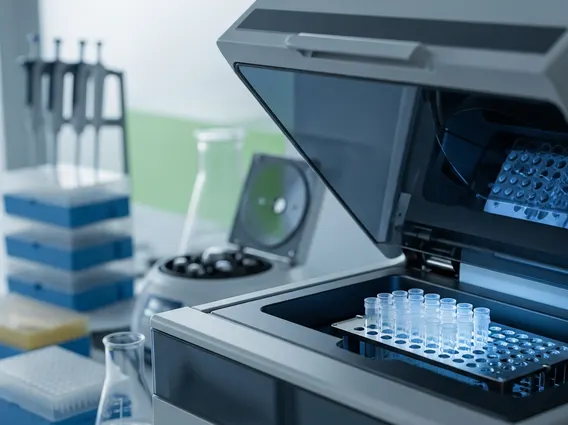
The mechanism behind PCR involves a series of temperature-dependent steps that are repeated multiple times, typically 20-40 cycles, in a thermal cycler. Each cycle effectively doubles the amount of the target DNA sequence. The primary components required for a PCR reaction include a DNA template, two oligonucleotide primers, a heat-stable DNA polymerase enzyme (commonly Taq polymerase), deoxyribonucleotides (dNTPs), and a buffer solution.
Each cycle of PCR consists of three main steps:
- Denaturation: The reaction mixture is heated to a high temperature (typically 94-98°C) to break the hydrogen bonds between the complementary strands of the double-stranded DNA template, separating them into single strands.
- Annealing: The temperature is lowered (typically 50-65°C) to allow the short, single-stranded DNA primers to bind (anneal) to their complementary sequences on the separated template DNA strands. These primers define the specific region of DNA to be amplified.
- Extension: The temperature is raised again (typically 72°C), which is the optimal temperature for the DNA polymerase enzyme to synthesize new DNA strands. The polymerase adds dNTPs to the 3′ end of each primer, extending them along the template strand to create new double-stranded DNA molecules.
This cyclical process leads to an exponential amplification of the target DNA sequence, making it detectable and quantifiable for further analysis.
PCR Test Applications, Types, and Results
What is PCR test used for?
PCR tests are incredibly versatile and are used across a broad spectrum of fields due to their high sensitivity and specificity. In clinical diagnostics, PCR is a cornerstone for identifying infectious agents, such as viruses (e.g., SARS-CoV-2, HIV, influenza) and bacteria (e.g., tuberculosis, Lyme disease). For instance, during the COVID-19 pandemic, RT-PCR became the gold standard for diagnosing active infections, with millions of tests performed globally (Source: World Health Organization). Beyond infectious diseases, PCR is critical in oncology for detecting cancer-specific mutations and monitoring treatment efficacy, and in genetics for diagnosing inherited disorders, prenatal screening, and forensic analysis.
The broad utility of types of PCR tests and applications extends to environmental testing, food safety, and agricultural research, where it can identify specific organisms or genetic traits.
Several variations of PCR have been developed to meet specific analytical needs:
- Reverse Transcription PCR (RT-PCR): Used to detect RNA sequences. An initial step converts RNA into complementary DNA (cDNA) using reverse transcriptase, which is then amplified by standard PCR. This is vital for RNA viruses like influenza and SARS-CoV-2.
- Quantitative PCR (qPCR) or Real-time PCR: Allows for the quantification of DNA or RNA in a sample as the amplification occurs in real-time. It uses fluorescent dyes or probes to monitor the accumulation of PCR products, providing information on the initial amount of target nucleic acid.
- Multiplex PCR: Amplifies multiple target DNA sequences simultaneously in a single reaction, saving time and resources.
- Nested PCR: Employs two sets of primers in two successive PCR reactions to increase sensitivity and specificity, often used for detecting very low copy numbers of target DNA.
When it comes to pcr test results explained, they are generally interpreted as positive or negative, or as a quantitative value. A positive result indicates the presence of the target nucleic acid (DNA or RNA), meaning the pathogen or genetic marker was detected in the sample. A negative result suggests the absence of the target nucleic acid or that its concentration was below the detection limit of the test. For quantitative PCR, results are often expressed as a viral load or gene expression level, providing insights into the severity of an infection or the activity of a gene. It is important to note that while PCR is highly accurate, results should always be interpreted in the context of a patient’s clinical symptoms and other diagnostic findings.