Optical Coherence Tomography
Optical Coherence Tomography is an advanced medical imaging technique that provides high-resolution, cross-sectional views of biological tissues. This non-invasive method has revolutionized diagnostics in various medical fields by enabling detailed visualization of microscopic structures.
Key Takeaways
- Optical Coherence Tomography (OCT) is a non-invasive imaging technology that produces high-resolution, cross-sectional images of tissue.
- It operates by measuring the backscattered light from tissue, similar to ultrasound but using light instead of sound waves.
- OCT is widely used in ophthalmology for diagnosing retinal diseases and in other fields like cardiology and dermatology.
- Key benefits include its non-invasive nature, high resolution, and ability to provide real-time, detailed anatomical information.
What Is Optical Coherence Tomography?
Optical Coherence Tomography (OCT) is a non-invasive diagnostic imaging technique that utilizes light waves to capture high-resolution, cross-sectional images of biological tissues. This advanced method provides detailed microscopic views, making it invaluable for examining the internal structures of organs without requiring incisions or contact. Essentially, OCT functions much like an ultrasound, but instead of sound waves, it employs light, allowing for significantly higher resolution imaging of superficial layers. It helps clinicians visualize tissue architecture in unprecedented detail, aiding in the early detection and precise monitoring of various medical conditions.
How Does Optical Coherence Tomography Work?
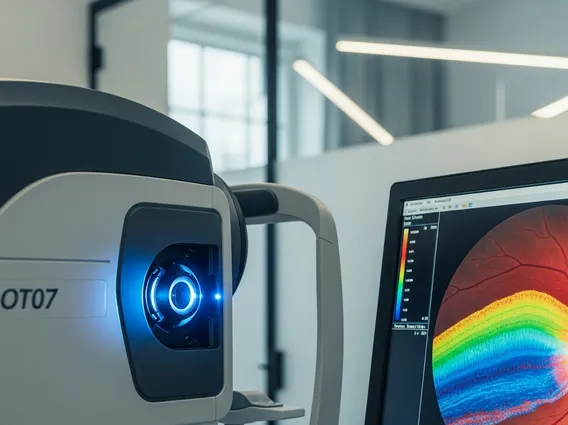
The operational principle behind Optical Coherence Tomography involves directing a beam of light, typically near-infrared, onto the tissue being examined. This light penetrates the tissue and is then reflected or “backscattered” from different layers within it. A detector measures the time delay and intensity of the reflected light. By comparing the reflected light with a reference beam, the system creates interference patterns. These patterns are then processed by a computer to construct a detailed, two-dimensional cross-sectional image of the tissue. Because light travels much faster than sound, OCT can acquire images rapidly, providing real-time visualization of tissue morphology with micron-level resolution. This capability allows for the precise identification of structural abnormalities that might be invisible with other imaging modalities.
Applications and Benefits of Optical Coherence Tomography (OCT)
The utility of Optical Coherence Tomography spans across numerous medical disciplines, making it a cornerstone diagnostic tool. The primary Optical Coherence Tomography uses and applications are found in ophthalmology, where it is indispensable for diagnosing and managing conditions affecting the retina and optic nerve. For instance, OCT is crucial for detecting early signs of age-related macular degeneration, glaucoma, and diabetic retinopathy, which together affect millions globally. According to the World Health Organization (WHO), glaucoma alone is a leading cause of irreversible blindness worldwide, and early detection via OCT can significantly impact patient outcomes.
Beyond eye care, OCT is increasingly employed in other specialties:
- Cardiology: Intravascular OCT provides high-resolution imaging of coronary arteries, aiding in the assessment of plaque characteristics and guiding stent placement.
- Dermatology: It assists in the non-invasive diagnosis of skin cancers and other dermatological conditions by visualizing subsurface tissue layers.
- Gastroenterology: Endoscopic OCT is used for imaging the mucosal lining of the gastrointestinal tract, detecting abnormalities like Barrett’s esophagus.
The Benefits of Optical Coherence Tomography are substantial. It is a non-invasive and radiation-free procedure, making it safe for repeated use. Its exceptional resolution allows for the detection of subtle pathological changes at an early stage, often before symptoms appear. This early detection capability is vital for initiating timely interventions and improving prognosis. Furthermore, OCT provides real-time imaging, which is beneficial for guiding surgical procedures and monitoring treatment efficacy. Its ability to offer detailed anatomical insights without invasive measures positions OCT as a powerful and patient-friendly diagnostic technology.