
Parapharyngeal Space
The parapharyngeal space is a critical anatomical region in the head and neck, often challenging to assess due to its deep location. Understanding this complex area is vital for diagnosing and treating various medical conditions.
Key Takeaways
- The parapharyngeal space is a deep, inverted pyramidal region in the neck, crucial for housing vital neurovascular structures.
- It is divided into prestyloid and poststyloid compartments by the styloid process and its associated fascia.
- This space contains major blood vessels, cranial nerves, lymph nodes, and salivary gland tissue.
- Common conditions affecting this space include infections (abscesses), benign and malignant tumors, and vascular anomalies.
- Due to its deep location and proximity to vital structures, conditions in the parapharyngeal space often require specialized diagnostic imaging and careful management.
What is the Parapharyngeal Space?
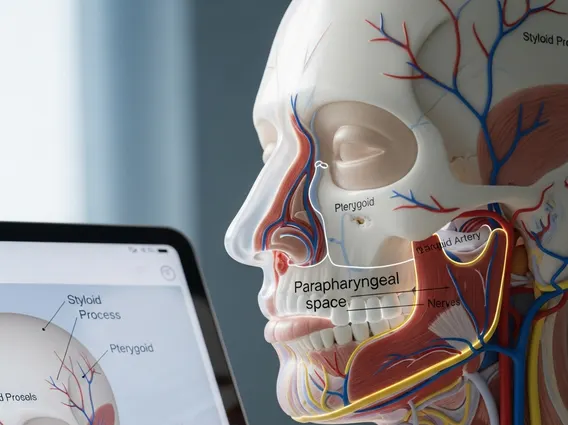
Parapharyngeal Space refers to a deep, inverted pyramidal fascial compartment located in the lateral neck, extending from the skull base superiorly to the hyoid bone inferiorly. This critical anatomical region is situated lateral to the pharynx and medial to the masticator space, playing a significant role in housing various vital structures. Understanding the parapharyngeal space definition and location is crucial for clinicians, as its deep and complex nature makes it a challenging area for diagnosis and surgical intervention.
This space is not merely an empty void but a potential space filled with loose connective tissue, fat, and numerous important neurovascular structures. Its strategic position means that pathologies originating here can have widespread effects, impacting functions such as swallowing, speech, and nerve function. The precise boundaries and contents of the parapharyngeal space are key to comprehending the presentation and management of conditions that arise within it.
Anatomy and Function of the Parapharyngeal Space
The parapharyngeal space anatomy and function are complex, as it serves as a conduit and protective enclosure for several essential structures. This space is typically divided into two main compartments by the styloid process and its associated fascia: the prestyloid (anterior) and poststyloid (posterior) compartments.
- Prestyloid Compartment: This anterior portion primarily contains the deep lobe of the parotid gland, fat, and lymph nodes. Tumors originating from the parotid gland are common in this area.
- Poststyloid Compartment: Also known as the carotid space, this posterior compartment is of immense clinical significance. It houses the carotid artery, internal jugular vein, and several cranial nerves (IX, X, XI, XII), along with sympathetic chain ganglia and lymph nodes. Pathologies here can therefore affect major vascular supply to the brain and critical neurological functions.
The primary function of the parapharyngeal space is to provide a protected pathway for these vital neurovascular structures as they traverse the neck. The loose connective tissue and fat within the space allow for some mobility and cushioning, accommodating movements of the pharynx and surrounding structures. Its fascial boundaries help to compartmentalize infections or tumors, though these boundaries can be breached, leading to spread into adjacent spaces.
Common Conditions Affecting the Parapharyngeal Space
The deep and intricate nature of this anatomical region makes it susceptible to a variety of pathologies. The common conditions of parapharyngeal space include both inflammatory processes and neoplastic growths, which can be benign or malignant. Due to the proximity of vital structures, even benign lesions can cause significant symptoms through compression.
One of the most frequent conditions is infection, often presenting as a parapharyngeal abscess. These can arise from dental infections, tonsillitis, or pharyngitis, spreading into the deep neck spaces. Symptoms typically include fever, sore throat, neck pain, and trismus (difficulty opening the mouth). According to a study published in the Journal of Oral and Maxillofacial Surgery, deep neck space infections, including those in the parapharyngeal space, account for approximately 10-20% of all head and neck infections requiring hospitalization.
Tumors are also a significant concern. Approximately 70-80% of parapharyngeal space tumors are benign. Common types of tumors include pleomorphic adenomas, originating from the deep lobe of the parotid gland in the prestyloid space. Paragangliomas (chemodectomas) are neuroendocrine tumors often found in the poststyloid carotid space, arising from the carotid body or vagal nerve. Schwannomas and neurofibromas are benign nerve sheath tumors, also common in the poststyloid space, affecting cranial nerves. Lymphoma can involve lymph nodes within the space.
Malignant tumors, though less common, include squamous cell carcinoma (often metastatic from other head and neck sites), adenoid cystic carcinoma, and sarcomas. Symptoms of tumors can vary widely depending on their size, location, and the structures they compress, ranging from a palpable neck mass to cranial nerve palsies, dysphagia (difficulty swallowing), or airway obstruction. Diagnosis typically involves advanced imaging techniques such as CT and MRI, often followed by biopsy.



















